
// threat brief
axios npm package poisoned: maintainer account stolen, 1.14.1 and 0.30.4 shipped a remote access trojan
- CVSS
- —
- CISA KEV
- Not listed
- Weakness
- CWE-506
- Topics
- Supply chain
Human review 2026-09-23Command tests: none yetReproduced: not yetVerification record ↓
Attackers hijacked an axios maintainer's npm account and published two versions with a malicious dependency; a plain npm install drops a remote access trojan.
| Who is affected | Developer machines and CI environments that installed or updated to axios 1.14.1 or 0.30.4 between about 00:21 and 03:15 (UTC) on 2026-03-31, when the malicious axios versions were removed (the malicious dependency plain-crypto-js stayed up until 03:29). Projects with a version range of ^1.14.0 or ^0.30.0 and no lockfile were the most likely to be hit. |
|---|---|
| What happens | The attacker gains remote control of that computer and can run commands and read files, which means access to every key and credential on it. |
| What to do now | Check your lockfile and node_modules for plain-crypto-js. If it's there, treat the machine as compromised and rotate all credentials from a separate, clean machine. Upgrade axios to 1.15.0 or 0.31.0 or later.View evidence(4)
|
| Affected versions | 1.14.1, 0.30.4 (plus the malicious dependency plain-crypto-js 4.2.1)View evidence(4)
|
| Fixed versions | The malicious versions have been removed; 1.15.0 or 0.31.0 or later is recommended (these also fix CVE-2026-40175)View evidence(4)
|
| Timeline | |
| CISA KEV | Not listed(Not being in KEV does not mean it has not been exploited)View evidence(4)
|
Blue team playbook
Check, fix / mitigate, respond, harden. Matching the affected versions does not mean you were compromised, and a check that finds nothing does not prove you are safe; each item says what it can and cannot show. Tagged steps point to where the attack flow below can be stopped.
- 01Check lockfiles and node_modules
Look for axios 1.14.1, 0.30.4 or plain-crypto-js. The malware rewrites its version to 4.2.0, so check whether the folder exists.
Read-only checkgrep -nE 'axios@(1\.14\.1|0\.30\.4)|plain-crypto-js' package-lock.json yarn.lock pnpm-lock.yaml 2>/dev/null ls node_modules/plain-crypto-js 2>/dev/null && echo "plain-crypto-js found" - 02Check CI build logs
Review builds between about 00:21 and 03:29 UTC on 2026-03-31 (the malicious axios versions were removed around 03:15, plain-crypto-js at 03:29) for npm installs that resolved those versions.
- 01Upgrade axios to 1.15.0 or 0.31.0 or later
This also fixes CVE-2026-40175.
- 02Block the published malicious domains and IPs
Block and search logs for the domains and IPs published by CISA and Google.
- 01Treat the affected machine as fully compromised
Removing the package does not remove what the attacker installed; isolate and investigate affected hosts.
- 02Rotate every credential from a clean machine
Version-control tokens, CI/CD secrets, cloud keys, npm tokens, SSH keys.
- 03Remove the malicious package and caches
Delete node_modules/plain-crypto-js/, run npm cache clean --force, and clear internal package caches too.
- 01Don't run install scripts by default
Set ignore-scripts=true in .npmrc, or use npm ci --ignore-scripts in CI.
- 02Delay new releases and pin versions
Set min-release-age=7 and commit your lockfile so dependencies never change without you knowing.
- 03Use phishing-resistant MFA on developer accounts
- 04Maintainers: publish with OIDC Trusted Publishing
Disable long-lived tokens that can publish manually.
Full remediation steps and notes
- First, check whether you were hit. Run the commands above on every project, every developer machine, and CI.
- If you were hit:
- Treat that machine as fully compromised. The GitHub advisory specifically warns that removing the package doesn’t remove whatever the attacker installed, and that credentials should be rotated from a separate, clean machine.
- Rotate every credential on that machine and in those pipelines: version control tokens, CI/CD secrets, cloud keys, npm tokens, SSH keys.
- Delete
node_modules/plain-crypto-js/, runnpm cache clean --force, and clear your company’s internal package caches as well. - Block the domains and IPs published by CISA and Google and search your logs for them; isolate and investigate affected hosts.
- Upgrade axios. During the incident, the maintainers and CISA advised rolling back to 1.14.0 (or 0.30.3). Those versions contain no malware but are still affected by a separate flaw, CVE-2026-40175, so we recommend going straight to 1.15.0 or 0.31.0 or later.
- Long-term hardening.
ignore-scripts,min-release-age, pinned version numbers, and phishing-resistant MFA on developer accounts; package maintainers should switch to OIDC Trusted Publishing.
Attack flow
Read left to right: this is the order the attack happens in. A blue shield means the step can be stopped; the earlier, the better. Click an icon for details.
- Attacker
Breaks into the maintainer's personal computer through social engineering
The maintainer's post-mortem says this was a targeted social engineering attack, and the malware gave the attacker their npm credentials.
Defense: Use phishing-resistant MFA (such as security keys) on developer accounts.
- Attacker
Manually publishes 1.14.1 and 0.30.4 with the stolen token
npm records show the previous 1.x release, 1.14.0, was published through GitHub Actions and OIDC (the 0.x line's 0.30.3 was published from a maintainer account). These two versions have no matching GitHub commit or tag; they were uploaded directly with the stolen token.
Defense: Allow only OIDC Trusted Publishing and disable long-lived tokens that can publish manually.
- Your system
A developer or CI runs npm install
The new versions add a dependency, plain-crypto-js, that axios never actually uses, and its install script (postinstall) runs automatically.
Defense: npm ci --ignore-scripts; set min-release-age to delay adopting new versions; pin versions with a lockfile.
- External
The install script downloads a remote access trojan for the victim's operating system
It supports Windows, macOS, and Linux. Afterwards it deletes itself and swaps the package manifest for a clean-looking version.
Defense: Restrict outbound connections from developer machines and CI; block the malicious domains and IPs published by the authorities and vendors.
- Attacker
Remotely controls the victim's computer
It can run commands, list files, and check in regularly, and on Windows it also sets itself up to run at startup.
Who is affected
| Condition | Affected? |
|---|---|
| Installed axios 1.14.1 or 0.30.4 between about 00:21 and 03:15 UTC on 2026-03-31 (before the malicious versions were removed) | Affected; treat that machine as compromised |
| Lockfile pinned to a different version, and dependencies were not re-resolved during that window | Not affected |
Installed with npm ci --ignore-scripts | The malicious install script does not run |
| axios 1.14.0, 0.30.3 | No malware, but still affected by CVE-2026-40175; upgrading is recommended |
How to check:
# Does the lockfile contain a malicious version or the malicious dependency?
grep -nE 'axios@(1\.14\.1|0\.30\.4)|plain-crypto-js' package-lock.json yarn.lock pnpm-lock.yaml 2>/dev/null
# Is this folder in node_modules? (The version number may have been faked as 4.2.0, so just check whether the folder exists)
ls node_modules/plain-crypto-js 2>/dev/null && echo "Found plain-crypto-js; follow the steps under How to fix"
Check your CI environments too: go through the build logs from that window and see whether any npm install resolved to the versions above.
How it works
This isn’t a vulnerability in axios’s code. It’s the publishing channel being taken over.
- The account was stolen. The maintainer’s personal computer was compromised through social engineering, leaking their npm credentials; Google’s report notes that the account’s email was also changed to an address the attacker controlled.
- The normal release process was bypassed. npm’s version records show that the previous 1.x release, 1.14.0, was published by GitHub Actions through OIDC (Trusted Publishing) with a provenance attestation. The 0.x line was different: the previous release, 0.30.3, was published directly from a maintainer account without those fields. These two malicious versions were uploaded manually with the stolen token and have no matching commit or tag.
- It was hidden in a dependency. axios’s own code was barely touched; the only change was a new dependency,
plain-crypto-js, inpackage.json. axios never uses it, but npm automatically runs itspostinstallscript during installation. - It covered its tracks. After downloading the trojan, the script deleted itself and swapped the package manifest for a clean-looking version 4.2.0. So when you check, look at whether the folder exists, not just the version number.
The risky setup:
Show code example(json)
{ "dependencies": { "axios": "^1.14.0" } }Without a lockfile, ^1.14.0 would automatically install whatever was newest at the time, which was 1.14.1.
A safer setup:
Show code example(ini)
# .npmrc
ignore-scripts=true      # don't run package install scripts by default
min-release-age=7        # don't automatically adopt versions published less than 7 days ago
Combine this with committing your lockfile and using npm ci in CI, and your dependency versions won’t change without you knowing.
Timeline
| Time (UTC) | Event |
|---|---|
| 2026-03-30 05:57 | Decoy package plain-crypto-js 4.2.0 (harmless) published |
| 2026-03-30 23:59 | Malicious plain-crypto-js 4.2.1 published |
| 2026-03-31 00:21 | axios 1.14.1 published |
| 2026-03-31 01:00 | axios 0.30.4 published; outside researchers start detecting anomalies |
| 2026-03-31 01:38 | axios collaborators begin responding and contact npm |
| 2026-03-31 about 03:15 | Both malicious versions removed; GitHub security advisory published |
| 2026-03-31 03:29 | plain-crypto-js removed |
| 2026-04-01 | Google and Microsoft publish their investigations and attributions |
| 2026-04-20 | CISA issues an alert |
Further reading
- No CVE. Malicious package incidents like this are usually tracked with GHSA or OSV MAL IDs; without a CVE, it also won’t appear in CISA’s KEV catalog.
- Attribution. Google attributes it with high confidence to UNC1069; Microsoft attributes it to Sapphire Sleet. Both point to North Korea, but whether they are the same group can’t be confirmed, so this page labels them separately.
- Figures on the number of affected projects and downloads come from secondhand sources, so this page does not cite them.
- Another supply chain incident from the same period: the Trivy supply chain attack.
Verification Reviewed and checked against sources; not yet reproduced in our lab
| Reviewed | 2026-09-23 |
|---|
Verification records describe the environment and the result only, never reproduction steps or code that could attack other people’s systems. See our policy.
Sources
- CVE / NVD / OSVCVE-2026-40175 Record (CVE Services API) · CVE Program, 2026-04-10 · accessed 2026-09-24A separate axios vulnerability (unrelated to this poisoning), affecting versions from 1.0.0 before 1.15.0 and before 0.31.0.
- OtherHuntress sees first real infection, on a Mac · www.huntress.com · accessed 2026-09-24
- AdvisoryPost-mortem: axios@1.14.1 and axios@0.30.4 compromise (issue #10636) · axios maintainers (GitHub), 2026-03-31 · accessed 2026-09-24
- AdvisoryGHSA-fw8c-xr5c-95f9 — Malware in axios · GitHub Advisory Database, 2026-03-31 · accessed 2026-09-23
- CVE / NVD / OSVMAL-2026-2307 · OSV / OpenSSF Malicious Packages, 2026-03-31 · accessed 2026-09-23
- AdvisorySupply Chain Compromise Impacts Axios Node Package Manager · CISA, 2026-04-20 · accessed 2026-09-23
- ResearchNorth Korea threat actor targets axios npm package · Google Threat Intelligence Group, 2026-04-01 · accessed 2026-09-23
- ResearchMitigating the axios npm supply chain compromise · Microsoft Security Blog, 2026-04-01 · accessed 2026-09-23
- Otheraxios 1.14.0 version metadata (npm registry) · npm registry · accessed 2026-09-24
- Otheraxios 0.30.3 version metadata (npm registry) · npm registry · accessed 2026-09-24
- Researchaxios compromised on npm — malicious versions drop remote access trojan · StepSecurity · accessed 2026-09-23
Share this page (X / Threads)
The post text comes straight from this page’s summary. When you paste the link, X and Threads show this image automatically.
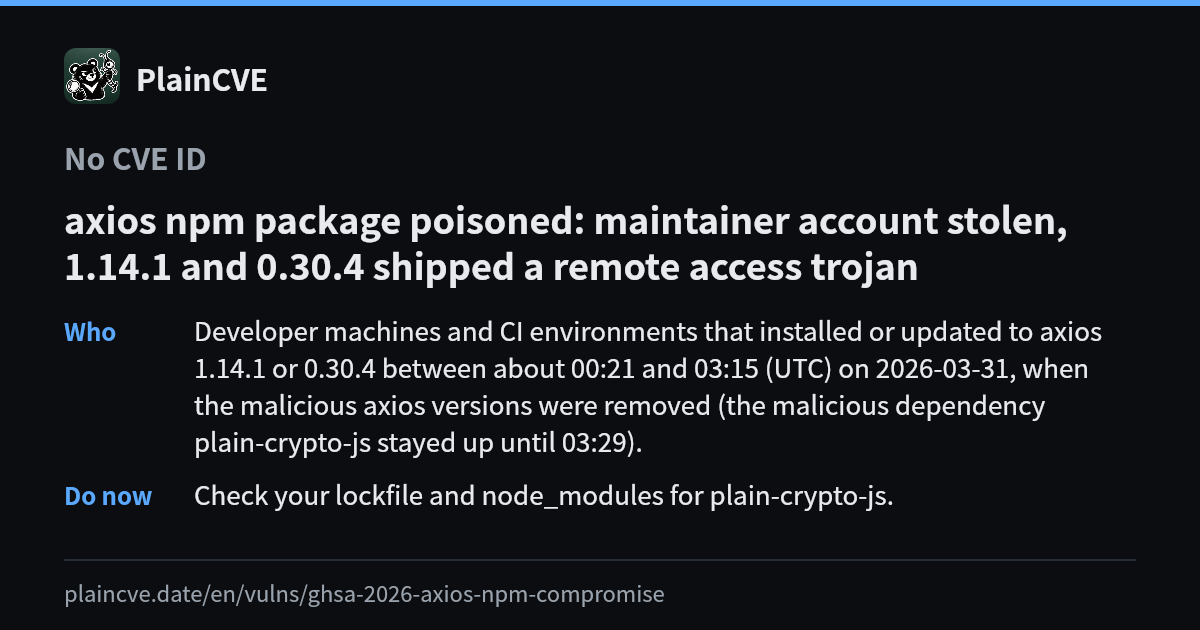
Attackers hijacked an axios maintainer's npm account and published two versions with a malicious dependency; a plain npm install drops a remote access trojan.
What to do: Check your lockfile and node_modules for plain-crypto-js.
https://plaincve.date/en/vulns/ghsa-2026-axios-npm-compromise
Attackers hijacked an axios maintainer's npm account and published two versions with a malicious dependency; a plain npm install drops a remote access trojan.

What to do: Check your lockfile and node_modules for plain-crypto-js.

https://plaincve.date/en/vulns/ghsa-2026-axios-npm-compromise
“Open” starts a new post on that platform in a new tab with the text filled in. We don’t track whether you share.
Press brief
In one sentence
On March 31, 2026, two versions of axios, a JavaScript package with extremely high weekly downloads, were laced with malware and stayed available online for about three hours. The attackers first broke into a maintainer's computer and hijacked the publishing account. Both Google and Microsoft attributed the incident to groups linked to North Korea. The incident has no CVE number; it is tracked as GHSA-fw8c-xr5c-95f9.
Key facts
- Malicious versions
- axios 1.14.1 and 0.30.4 github.com
- Time online
- About 3 hours (2026-03-31 00:21 to about 03:15 UTC; the malicious dependency was removed at 03:29) github.com
- Tracking ID
- GHSA-fw8c-xr5c-95f9 (no CVE) github.com
- Google attribution
- UNC1069 (linked to North Korea) cloud.google.com
- Microsoft attribution
- Sapphire Sleet (linked to North Korea) microsoft.com
- CISA alert
- 2026-04-20 cisa.gov
Confirmed
- The attackers used stolen npm credentials to publish the two versions by hand; neither has a matching GitHub commit or tag.
- The malware was hidden in a newly added dependency, plain-crypto-js, which runs automatically on install and targets Windows, macOS and Linux.
- Both malicious versions were taken down within about three hours.
Unconfirmed / disputed
- How many projects were affected and how many times the versions were downloaded: public figures come from secondary sources, so this page does not cite them.
- Whether the groups named by Google and Microsoft are the same group.
Quotable line
The attackers didn't change a single line of axios's actual functionality. They just added one dependency, and npm install ran it for you.
Images
Download the share image (PNG) · Attack flow diagram (downloadable)
Please credit "PlainCVE" and link to this page. Full citation format is under "How to cite" below. Found a factual error? Report it.
axios npm package poisoned: maintainer account stolen, 1.14.1 and 0.30.4 shipped a remote access trojan

On March 31, 2026, two versions of axios, a JavaScript package with extremely high weekly downloads, were laced with malware and stayed available online for about three hours. The attackers first broke into a maintainer's computer and hijacked the publishing account. Both Google and Microsoft attributed the incident to groups linked to North Korea. The incident has no CVE number; it is tracked as GHSA-fw8c-xr5c-95f9.

Key facts:
- Malicious versions:axios 1.14.1 and 0.30.4(https://github.com/advisories/GHSA-fw8c-xr5c-95f9)
- Time online:About 3 hours (2026-03-31 00:21 to about 03:15 UTC; the malicious dependency was removed at 03:29)(https://github.com/axios/axios/issues/10636)
- Tracking ID:GHSA-fw8c-xr5c-95f9 (no CVE)(https://github.com/advisories/GHSA-fw8c-xr5c-95f9)
- Google attribution:UNC1069 (linked to North Korea)(https://cloud.google.com/blog/topics/threat-intelligence/north-korea-threat-actor-targets-axios-npm-package)
- Microsoft attribution:Sapphire Sleet (linked to North Korea)(https://www.microsoft.com/en-us/security/blog/2026/04/01/mitigating-the-axios-npm-supply-chain-compromise/)
- CISA alert:2026-04-20(https://www.cisa.gov/news-events/alerts/2026/04/20/supply-chain-compromise-impacts-axios-node-package-manager)

Confirmed:
- The attackers used stolen npm credentials to publish the two versions by hand; neither has a matching GitHub commit or tag.
- The malware was hidden in a newly added dependency, plain-crypto-js, which runs automatically on install and targets Windows, macOS and Linux.
- Both malicious versions were taken down within about three hours.

Unconfirmed / disputed:
- How many projects were affected and how many times the versions were downloaded: public figures come from secondary sources, so this page does not cite them.
- Whether the groups named by Google and Microsoft are the same group.

「The attackers didn't change a single line of axios's actual functionality. They just added one dependency, and npm install ran it for you.」— PlainCVE
https://plaincve.date/en/vulns/ghsa-2026-axios-npm-compromise
How to cite this page
This article is CC BY 4.0. Please keep the attribution and link when republishing.
PlainCVE Team (2026). "axios npm package poisoned: maintainer account stolen, 1.14.1 and 0.30.4 shipped a remote access trojan". PlainCVE. https://plaincve.date/en/vulns/ghsa-2026-axios-npm-compromise (accessed YYYY-MM-DD)BibTeX
@misc{ghsa2026axiosnpmcompromise2026,
  title  = {axios npm package poisoned: maintainer account stolen, 1.14.1 and 0.30.4 shipped a remote access trojan},
  author = {PlainCVE Team},
  year   = {2026},
  howpublished = {PlainCVE},
  url    = {https://plaincve.date/en/vulns/ghsa-2026-axios-npm-compromise},
  note   = {Updated 2026-09-24}
}