
// threat brief
Cisco Catalyst SD-WAN Manager API authentication bypass: mishandled URL encoding gives unauthenticated attackers admin access
- CVSS
- 9.8 CRITICAL
- CISA KEV
- 2026-09-30
- Weakness
- CWE-177
- Topics
- Infrastructure · Web apps
AI review 2026-10-07 (not human-reviewed)Command tests: none yetReproduced: not yetVerification record ↓
A URL-encoding flaw lets unauthenticated remote attackers into the Cisco Catalyst SD-WAN Manager API as admin. Exploited in the wild.
| Who is affected | Organizations running Cisco Catalyst SD-WAN Manager on a release older than the first fixed release in its train, regardless of configuration. Cisco says systems with ports exposed to the internet are at risk of compromise. Cisco SD-WAN Cloud (Cisco Managed) is fixed in 20.15.605; Cisco Cloud Hosted environments have Cisco's network-access mitigation in place, but Cisco does not say they are fixed. |
|---|---|
| What happens | Without any username or password, an attacker can use the SD-WAN Manager API as the admin user. PlainCVE's assessment: SD-WAN Manager is the central console for a company's wide-area network, so admin access to it could potentially affect network-wide configuration. |
| What to do now | Upgrade to the fixed release that Cisco's advisory lists for your train (for example 20.9.10.1, 20.12.8.2, 20.15.6.1, 20.18.4.1, 26.1.2.1, 26.2.1); releases earlier than 20.9 must migrate to a fixed release. Note that the CVE record, also filed by Cisco, lists builds derived from these fixed releases (such as 20.9.10.1.01, 20.12.8.2.01 and 26.2.1_LI_Images) and versions in the 20.10, 20.11, 20.13, 20.14, 20.16 and 26.0 trains as affected; if you run one of these, check with Cisco. There is no workaround. Until you upgrade, block access from untrusted networks such as the internet, and check logs as Cisco describes. |
| Affected versions | All releases earlier than 20.9; 20.9 before 20.9.10.1; 20.12 before 20.12.8.2; 20.15 before 20.15.6.1; 20.18 before 20.18.4.1; 26.1 before 26.1.2.1; 26.2 before 26.2.1 (per Cisco's advisory fixed-release table; the itemized list of affected versions in the CVE record filed by Cisco also includes versions in the 20.10, 20.11, 20.13, 20.14 and 20.16 trains, 26.0.1, and the builds derived from fixed releases 20.9.10.1.01, 20.12.8.2.01, 20.15.6.1.01, 20.18.4.1.01, 26.1.2.1.01, 26.2.1_LI_Images, 26.1.2.1_LI_Images, 20.15.6.1_LI_Images and 20.18.4.1_LI_Images, so the two disagree; see body) |
| Fixed versions | Per Cisco's advisory: 20.9.10.1, 20.12.8.2, 20.15.6.1, 20.18.4.1, 26.1.2.1, 26.2.1; Cisco SD-WAN Cloud (Cisco Managed) 20.15.605. The CVE record, also filed by Cisco, marks no version as unaffected and lists builds derived from these fixed releases (20.9.10.1.01, 20.12.8.2.01, 20.15.6.1.01, 20.18.4.1.01, 26.1.2.1.01, 26.2.1_LI_Images, 26.1.2.1_LI_Images, 20.15.6.1_LI_Images, 20.18.4.1_LI_Images) as affected; if you run one of these, check with Cisco |
| CVSS vector | Show full vectorCVSS:3.1/AV:N/AC:L/PR:N/UI:N/S:U/C:H/I:H/A:H |
| Timeline |
|
| CISA KEV | Listed (2026-09-30): attacks have been seen in the wild |
Blue team playbook
Check, fix / mitigate, respond, harden. Matching the affected versions does not mean you were compromised, and a check that finds nothing does not prove you are safe; each item says what it can and cannot show. Tagged steps point to where the attack flow below can be stopped.
- 01Check how you deploy it and which release you run
Systems on a release older than the first fixed release in their train are affected, regardless of configuration (Cisco-managed SD-WAN Cloud 20.15.605 is fixed). Cisco-managed SD-WAN Cloud is already fixed and needs no action. If you are on the 20.10, 20.11, 20.13, 20.14 or 20.16 train, Cisco's advisory fixed-release table does not list it, but the CVE record filed by Cisco lists versions such as 20.10.1, 20.11.1, 20.13.1, 20.14.1 and 20.16.1 as affected. The advisory does not say which release these trains should upgrade to; ask Cisco directly. If you are on the 26.0 train, the advisory table does not list it either, but the CVE record lists 26.0.1 as affected; ask Cisco. If you run a build whose name is based on a fixed release, note that the CVE record lists 20.9.10.1.01, 20.12.8.2.01, 20.15.6.1.01, 20.18.4.1.01, 26.1.2.1.01, 26.2.1_LI_Images, 26.1.2.1_LI_Images, 20.15.6.1_LI_Images and 20.18.4.1_LI_Images as affected (while the advisory names 20.9.10.1, 26.2.1 and so on as first fixed releases). Don't conclude you are unaffected just because your version number is at or above the advisory's fixed release; check with Cisco.
- 02Audit the service proxy access log
Cisco advises checking serviceproxy-access.log for entries related to j_security_check from unknown or unauthorized IP addresses. Cisco's example entry is "POST /%6a_security_check" (j encoded as %6a), and Cisco says any one character may be encoded, so searching for the literal j_security_check would miss it. The command below (written by PlainCVE; it only reads your own log) matches "_securi" or "ty_check". If only one character in the path is encoded, at least one of the two still matches; if several characters are encoded it can still miss entries. Normal logins also match, and Cisco warns these signs can appear during normal operations, so compare each match with normal activity.
Read-only checkgrep -E '_securi|ty_check' /var/log/nms/containers/service-proxy/serviceproxy-access.log - 03Audit vmanage-server.log for reserved usernames
Cisco advises checking vmanage-server.log for entries related to j_security_check from unknown IP addresses, especially for usernames starting with viptela-reserved-. Cisco's example is "Request Stored in Map is (/%6a_security_check) for user (viptela-reserved-..)", which does not contain the literal string j_security_check. The command below (written by PlainCVE; it only reads your own log) therefore looks for viptela-reserved- first and then filters with a pattern that does not depend on the letter j; it can still miss entries if several characters are encoded. False positives are possible here too, so review each match.
Read-only checkgrep viptela-reserved- /var/log/nms/vmanage-server.log | grep -E '_securi|ty_check'
- 01Upgrade to a fixed release
Cisco strongly recommends upgrading and treats any mitigation as temporary. Releases earlier than 20.9 have no fix and must migrate to a fixed release.
- 02Can't upgrade yet: block access from untrusted networks
Cisco says there is no workaround; the temporary mitigation for on-premises deployments is to restrict access from untrusted networks such as the internet. Cisco proved it in a test environment but says customers should judge whether it fits their own environment. Cisco Cloud Hosted environments already have this mitigation.
- 03Can't upgrade yet: Cisco's Live Protect shield (temporary, partial protection)
Version 1.1 of Cisco's advisory (2026-10-02) adds that Cisco has released a Live Protect shield for this vulnerability as temporary coverage while customers plan upgrades. Cisco says it offers only temporary partial protection and that the only way to remediate is to upgrade to the first fixed release. Side effect if the shield is applied, per Cisco, a legitimate user with URI encoding might not be able to log in to SD-WAN Manager. Read Cisco's advisory before deploying it.
- 01Collect an admin-tech file and contact Cisco TAC
If you suspect compromise, Cisco encourages you to run request admin-tech on SD-WAN Manager (vManage) before opening a TAC case, to produce an admin-tech diagnostic file for TAC to review. Note: this is an SD-WAN Manager CLI command, not a bash/zsh command, and it creates a file on the system (it modifies the environment).
Read-only checkrequest admin-tech - 02Don't assume upgrading removes an attacker
Cisco's advisory does not say whether upgrading removes an attacker who already has access (a news report points this out too). PlainCVE's suggestion: if you find suspicious log entries, have TAC assess them rather than closing the case after upgrading alone.
- 01Keep the management platform off the internet
Cisco says SD-WAN Manager systems with ports exposed to the internet are at risk of compromise. Long term, allow connections only from trusted management networks.
Full remediation steps and notes
- Check how you deploy it first. Cisco SD-WAN Cloud (Cisco Managed) is fixed in 20.15.605 and needs no action. For Cisco Catalyst SD-WAN Cloud Hosted, Cisco says only that the network-access mitigation is already in place, not that it is fixed. Check your upgrade status with Cisco. The steps below apply to on-premises systems.
- Upgrade to the fixed release in the table above (per Cisco’s advisory). Releases earlier than 20.9 have no direct fix and must migrate to a fixed release. PlainCVE’s suggestion: migration may take longer to plan, so apply step 3 first. Note: the CVE record lists builds derived from these fixed releases (such as 20.12.8.2.01 and 26.2.1_LI_Images) as affected. If you run one of those builds, or the 20.10, 20.11, 20.13, 20.14, 20.16 or 26.0 train (not in the advisory table), don’t treat an upgrade as fixed without checking with Cisco.
- Restrict access before you upgrade. There is no workaround; Cisco’s temporary mitigation is to block connections from untrusted networks such as the internet. Cisco proved it only in a test environment, so confirm it works in yours. Version 1.1 of Cisco’s advisory (2026-10-02) also offers a Live Protect shield; Cisco says it provides only temporary partial protection, and once it is applied a legitimate user with URI encoding might not be able to log in. Upgrading remains the only remediation.
- Check the logs. The two files are
/var/log/nms/containers/service-proxy/serviceproxy-access.logand/var/log/nms/vmanage-server.log. Look for j_security_check entries from unknown IPs; in the second file, pay special attention to usernames starting withviptela-reserved-. Cisco says any one character in the path may be URL-encoded (its example is%6a_security_check), so don’t search only for the literalj_security_check. Cisco warns these entries can also appear during normal operations, so a match is not proof of compromise. - If you suspect compromise. Before opening a TAC case, run
request admin-techfrom the SD-WAN Manager (vManage) CLI, not a Linux shell, to collect a diagnostic file. The command creates a file on the system. Cisco has not said whether upgrading removes an attacker who already got in, so PlainCVE suggests not treating the upgrade as the end of the investigation.
Attack flow
Read left to right: this is the order the attack happens in. A blue shield means the step can be stopped; the earlier, the better. Click an icon for details.
Read top to bottom: this is the order the attack happens in. A blue shield means the step can be stopped; the earlier, the better. Tap an icon for details.
- Attacker
Sends a crafted HTTP request to the SD-WAN Manager API over the network
No login and no user interaction are needed. Cisco says systems with ports exposed to the internet are at risk of compromise.
Defense: Cisco's temporary mitigation: block access from untrusted networks such as the internet.
- Your system
The system mishandles the URL encoding
An authentication rule is meant to restrict access to one specific API endpoint, but because the encoding is handled improperly, the request is not caught by that rule.
Defense: Upgrade to a fixed release.
- Your system
Authentication is bypassed and the request is handled as the admin user
Cisco says a successful exploit gives the attacker access to the API as the admin user.
Defense: Upgrade to a fixed release; there is no workaround.
- Attacker
The attacker uses the SD-WAN Manager API with admin privileges
Researchers at Horizon3.ai say admin holds the netadmin role by default, which permits all operations (Cisco's advisory does not say this). What attackers actually did has not been made public.
Defense: Check serviceproxy-access.log and vmanage-server.log for j_security_check-related entries from unknown IPs, as Cisco advises. Cisco warns that characters in the path may be URL-encoded (for example %6a_security_check), so searching only for the literal string j_security_check will miss them.
Who is affected
Cisco says Catalyst SD-WAN Manager is affected regardless of system configuration, and that systems with ports exposed to the internet are at risk of compromise.
| Release train | First fixed release |
|---|---|
| Earlier than 20.9 | No fix; migrate to a fixed release |
| 20.9 | 20.9.10.1 |
| 20.12 | 20.12.8.2 |
| 20.15 | 20.15.6.1 |
| 20.18 | 20.18.4.1 |
| 26.1 | 26.1.2.1 |
| 26.2 | 26.2.1 |
| Cisco SD-WAN Cloud (Cisco Managed) | Fixed in 20.15.605; no customer action needed |
Caveats:
The table above follows the fixed-release table in Cisco’s advisory. The CVE record, also filed by Cisco (updated 2026-10-02), presents the versions differently. The two primary sources disagree, so this page lists both and does not choose between them:
- How the CVE record lists versions. Instead of a version range, the record itemizes affected versions one by one, from 17.2.4 through 18.x, 19.x, 20.x and 26.x, including 20.9.x, 20.12.x, 20.15.x, 20.18.x, 26.0.1 and 26.1.x. Versions not listed have the status “unknown” (defaultStatus: unknown).
- Trains missing from the advisory table. Cisco’s advisory fixed-release table does not list the 20.10, 20.11, 20.13, 20.14 or 20.16 trains (The Hacker News also points this out and says Cisco’s May advisory did list them). The CVE record lists versions such as 20.10.1, 20.11.1, 20.13.1, 20.14.1 and 20.16.1 as affected. Cisco’s advisory does not say which release these trains should upgrade to.
- The 26.0 train. Cisco’s advisory fixed-release table has no 26.0 train, and 26.0 is not “earlier than 20.9”; the CVE record lists 26.0.1 as affected. If you run 26.0.x, ask Cisco.
- Builds derived from fixed releases. The CVE record also lists as affected some builds whose names are based on fixed releases, such as 20.9.10.1.01, 20.12.8.2.01, 20.15.6.1.01, 20.18.4.1.01 and 26.1.2.1.01, plus 26.2.1_LI_Images, 26.1.2.1_LI_Images, 20.15.6.1_LI_Images and 20.18.4.1_LI_Images. The CVE record marks no version as unaffected. The advisory, by contrast, names 20.9.10.1, 26.2.1 and so on as first fixed releases. No source explains the difference. If you run one of these builds, check with Cisco.
How it works
SD-WAN Manager offers an API (an interface other programs use to send it commands over the network) and uses “sessions” (a credential you get after logging in) to control who can use it. One authentication rule exists specifically to restrict access to a particular API endpoint.
The problem is URL encoding: characters in a web address can be rewritten as ”%” plus digits, so the same path can be written several ways. Cisco says the system mishandles URL encoding in HTTP requests, letting a crafted request slip past that authentication rule and end up accessing the API as the admin user. Cisco classifies this as CWE-177 (Improper Handling of URL Encoding). The attacker needs no login and no user interaction.
The sources provided give no technical detail beyond Cisco’s one-sentence description. Below is a common illustration of this kind of weakness, written by PlainCVE; it is not Cisco’s code:
The flawed approach (conceptual illustration):
Show code example(python)
# The rule is checked against the still-encoded path
if matches_protected_rule(request.raw_path):
    require_login()
# but routing uses the decoded path
route(url_decode(request.raw_path))
The fixed approach (conceptual illustration):
Show code example(python)
# Decode and normalize once; check and route on the same value
path = normalize(url_decode(request.raw_path))
if matches_protected_rule(path):
    require_login()
route(path)
What a successful attack achieves: Cisco says admin-level access to the API. Researchers at Horizon3.ai add that the admin user holds the netadmin role by default, which permits all operations, but Cisco’s advisory does not say this. No source says the flaw leads to code execution on the underlying operating system.
Timeline
| Date | Event |
|---|---|
| 2026-08-19 | CVE ID reserved |
| 2026-09 (exact date not public) | Cisco PSIRT becomes aware of active exploitation |
| 2026-09-30 13:00 GMT | Cisco publishes its advisory (listing fixed releases) |
| 2026-09-30 | CVE record published; CISA adds it to the Known Exploited Vulnerabilities catalog |
| 2026-10-03 | CISA remediation deadline for US federal agencies |
No source says when exploitation actually began.
Further reading
- Scoring: Cisco rates it CVSS 3.1 9.8 (Critical).
- Zero-day or not: The Hacker News calls it a zero-day (exploited before a fix existed), and security firm Field Effect says attackers were targeting vulnerable systems before updates were available. Cisco’s advisory itself does not use that term; it only says Cisco learned of exploitation in September.
- Attack details not public: According to The Hacker News, Cisco’s advisory does not say when attacks began, who carried them out, how many customers were hit, or what the attackers did with their access. KEV lists known ransomware use as “Unknown”.
- How it was found: The Source section of Cisco’s advisory says the vulnerability was found while a Cisco TAC support case was being resolved (The Hacker News reports the same). The CVE record lists the discovery source as external (EXTERNAL).
- Cisco bug ID CSCww79570; weakness type CWE-177.
Verification Checked item by item against sources by AI under our review rules, all passed; not human-reviewed and not yet reproduced in our lab
| AI review | 2026-10-07 · review rules |
|---|
Verification records describe the environment and the result only, never reproduction steps or code that could attack other people’s systems. See our policy.
Sources
- AdvisoryCisco Catalyst SD-WAN Manager Authentication Bypass Vulnerability (cisco-sa-sdwan-webauth-xr8beuuU) · Cisco, 2026-09-30 · accessed 2026-10-01
- CVE / NVD / OSVCVE-2026-76504 CVE record (JSON) · CVE Program, 2026-09-30 · accessed 2026-10-01
- CVE / NVD / OSVNVD API - CVE-2026-76504 · NIST · accessed 2026-10-01
- OtherCISA Known Exploited Vulnerabilities Catalog (JSON feed, cisagov/kev-data) · CISA, 2026-09-30 · accessed 2026-10-07
- ResearchCVE-2026-76504 · Horizon3.ai · accessed 2026-10-01
- ResearchExploitation of Cisco Catalyst SD-WAN Manager · Field Effect · accessed 2026-10-01
- NewsCisco warns of attackers exploiting SD-WAN Manager zero-day · The Hacker News · accessed 2026-10-01
Share this page (X / Threads)
The post text comes straight from this page’s summary. When you paste the link, X and Threads show this image automatically.
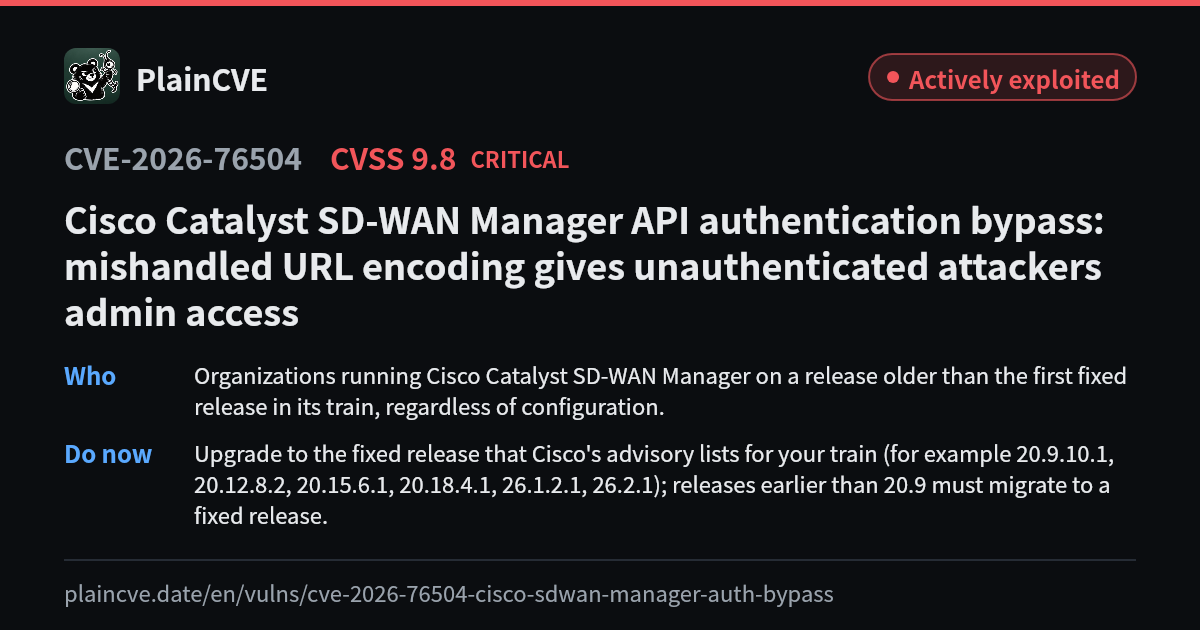
⚠ Actively exploited · CVE-2026-76504
A URL-encoding flaw lets unauthenticated remote attackers into the Cisco Catalyst SD-WAN Manager API as admin. Exploited in the wild.
https://plaincve.date/en/vulns/cve-2026-76504-cisco-sdwan-manager-auth-bypass
⚠ Actively exploited · CVE-2026-76504
A URL-encoding flaw lets unauthenticated remote attackers into the Cisco Catalyst SD-WAN Manager API as admin. Exploited in the wild.

What to do: Upgrade to the fixed release that Cisco's advisory lists for your train (for example 20.9.10.1, 20.12.8.2, 20.15.6.1, 20.18.4.1, 26.1.2.1, 26.2.1); releases earlier than 20.9 must migrate to a fixed release.

https://plaincve.date/en/vulns/cve-2026-76504-cisco-sdwan-manager-auth-bypass
“Open” starts a new post on that platform in a new tab with the text filled in. We don’t track whether you share.
Press brief
In one sentence
Cisco Catalyst SD-WAN Manager is the platform companies use to centrally manage their wide-area networks. Its API authentication has a flaw: because URL encoding is mishandled, an unauthenticated remote attacker can bypass login and access the system as the admin user. Cisco says it learned of active exploitation in September 2026 and published its advisory with fixed releases on September 30; the US agency CISA added it to its Known Exploited Vulnerabilities catalog the same day.
Key facts
- Severity
- CVSS 3.1 9.8 (Critical) sec.cloudapps.cisco.com
- Cisco advisory published
- 2026-09-30 sec.cloudapps.cisco.com
- Added to CISA KEV
- 2026-09-30 (federal remediation due 2026-10-03) services.nvd.nist.gov
- Cisco bug ID
- CSCww79570 sec.cloudapps.cisco.com
- Weakness type
- CWE-177 (Improper Handling of URL Encoding) sec.cloudapps.cisco.com
Confirmed
- An unauthenticated remote attacker can bypass authentication and access the API as the admin user (Cisco).
- Cisco PSIRT became aware of active exploitation in September 2026.
- CISA added it to the Known Exploited Vulnerabilities catalog on 2026-09-30.
- There is no workaround; Cisco has released fixed software, and its managed cloud service is already fixed.
Unconfirmed / disputed
- Cisco has not said when attacks began, who carried them out, or how many customers were hit.
- The itemized affected-version list in the CVE record filed by Cisco (updated 2026-10-02) does not match the fixed-release table in Cisco's advisory. The record also lists versions in the 20.10, 20.11, 20.13, 20.14 and 20.16 trains, 26.0.1, plus some builds derived from fixed releases (such as 20.9.10.1.01 and 26.2.1_LI_Images), as affected. No source explains why.
- News outlets call it a zero-day; Cisco's advisory does not say so itself.
- No source says the flaw leads to code execution on the underlying operating system.
Quotable line
Write the same address a different way and the guard at the door no longer recognizes it: that is the heart of this flaw.
Images
Download the share image (PNG) · Attack flow diagram (downloadable)
Please credit "PlainCVE" and link to this page. Full citation format is under "How to cite" below. Found a factual error? Report it.
Cisco Catalyst SD-WAN Manager API authentication bypass: mishandled URL encoding gives unauthenticated attackers admin access

Cisco Catalyst SD-WAN Manager is the platform companies use to centrally manage their wide-area networks. Its API authentication has a flaw: because URL encoding is mishandled, an unauthenticated remote attacker can bypass login and access the system as the admin user. Cisco says it learned of active exploitation in September 2026 and published its advisory with fixed releases on September 30; the US agency CISA added it to its Known Exploited Vulnerabilities catalog the same day.

Key facts:
- Severity:CVSS 3.1 9.8 (Critical)(https://sec.cloudapps.cisco.com/security/center/content/CiscoSecurityAdvisory/cisco-sa-sdwan-webauth-xr8beuuU)
- Cisco advisory published:2026-09-30(https://sec.cloudapps.cisco.com/security/center/content/CiscoSecurityAdvisory/cisco-sa-sdwan-webauth-xr8beuuU)
- Added to CISA KEV:2026-09-30 (federal remediation due 2026-10-03)(https://services.nvd.nist.gov/rest/json/cves/2.0?cveId=CVE-2026-76504)
- Cisco bug ID:CSCww79570(https://sec.cloudapps.cisco.com/security/center/content/CiscoSecurityAdvisory/cisco-sa-sdwan-webauth-xr8beuuU)
- Weakness type:CWE-177 (Improper Handling of URL Encoding)(https://sec.cloudapps.cisco.com/security/center/content/CiscoSecurityAdvisory/cisco-sa-sdwan-webauth-xr8beuuU)

Confirmed:
- An unauthenticated remote attacker can bypass authentication and access the API as the admin user (Cisco).
- Cisco PSIRT became aware of active exploitation in September 2026.
- CISA added it to the Known Exploited Vulnerabilities catalog on 2026-09-30.
- There is no workaround; Cisco has released fixed software, and its managed cloud service is already fixed.

Unconfirmed / disputed:
- Cisco has not said when attacks began, who carried them out, or how many customers were hit.
- The itemized affected-version list in the CVE record filed by Cisco (updated 2026-10-02) does not match the fixed-release table in Cisco's advisory. The record also lists versions in the 20.10, 20.11, 20.13, 20.14 and 20.16 trains, 26.0.1, plus some builds derived from fixed releases (such as 20.9.10.1.01 and 26.2.1_LI_Images), as affected. No source explains why.
- News outlets call it a zero-day; Cisco's advisory does not say so itself.
- No source says the flaw leads to code execution on the underlying operating system.

「Write the same address a different way and the guard at the door no longer recognizes it: that is the heart of this flaw.」— PlainCVE
https://plaincve.date/en/vulns/cve-2026-76504-cisco-sdwan-manager-auth-bypass
How to cite this page
This article is CC BY 4.0. Please keep the attribution and link when republishing.
PlainCVE Team (2026). "Cisco Catalyst SD-WAN Manager API authentication bypass: mishandled URL encoding gives unauthenticated attackers admin access". PlainCVE. https://plaincve.date/en/vulns/cve-2026-76504-cisco-sdwan-manager-auth-bypass (accessed YYYY-MM-DD)BibTeX
@misc{cve202676504ciscosdwanmanagerauthbypass2026,
  title  = {Cisco Catalyst SD-WAN Manager API authentication bypass: mishandled URL encoding gives unauthenticated attackers admin access},
  author = {PlainCVE Team},
  year   = {2026},
  howpublished = {PlainCVE},
  url    = {https://plaincve.date/en/vulns/cve-2026-76504-cisco-sdwan-manager-auth-bypass},
  note   = {Updated 2026-10-07}
}