
// threat brief
LiteLLM Proxy MCP gateway authentication bypass: any made-up token can call MCP tools
- CVSS
- 8.2 HIGH
- CISA KEV
- 2026-09-02
- Weakness
- CWE-287 · CWE-306
- Topics
- AI security
Human review 2026-09-23Command tests: none yetReproduced: not yetVerification record ↓
LiteLLM Proxy's MCP endpoints let failed logins through as anonymous, so anyone can list and call its MCP tools with no account. Exploited in the wild.
| Who is affected | Organizations running LiteLLM Proxy before 1.84.0 with MCP servers configured, where the MCP routes are reachable from an untrusted network. |
|---|---|
| What happens | An attacker can use the gateway to operate the MCP tools and services you've connected, such as reading and writing tickets, code repositories, or databases. What they can do depends on which tools you've connected. |
| What to do now | Upgrade litellm to 1.84.0 or later. If you can't upgrade right away, block the /mcp/ paths at your reverse proxy or API gateway.View evidence(4)
|
| Affected versions | All versions before 1.84.0View evidence(3)
|
| Fixed versions | 1.84.0 or laterView evidence(3)
|
| CVSS vector | Show full vectorCVSS:3.1/AV:N/AC:L/PR:N/UI:N/S:U/C:H/I:L/A:N |
| Timeline |
|
| CISA KEV | Listed (2026-09-02): attacks have been seen in the wildView evidence(3)
|
Blue team playbook
Check, fix / mitigate, respond, harden. Matching the affected versions does not mean you were compromised, and a check that finds nothing does not prove you are safe; each item says what it can and cannot show. Tagged steps point to where the attack flow below can be stopped.
- 01Check your version and exposure
You are affected only if all three hold: LiteLLM Proxy before 1.84.0, MCP servers configured, and MCP routes reachable from untrusted networks.
Read-only checkpip show litellm | grep -i '^version' - 02Look for signs of exploitation
First exclude legitimate passthrough to MCP servers configured for OAuth2 (those tokens are never LiteLLM keys, and the fix still allows them). Then investigate non-OAuth2 targets that accepted unknown tokens, unusual tool calls, and the authorization results on the upstream services. A token that matched no LiteLLM key but succeeded is not, on its own, proof of compromise.
- 01Upgrade to 1.84.0 or later
After the fix, passthrough is allowed only when every target server is configured for oauth2; everything else is rejected.
Changes your environmentpip install -U "litellm>=1.84.0" - 02Can't upgrade yet: block /mcp/ at the reverse proxy
Official advice: disable or block /mcp/ and related endpoints at your reverse proxy or API gateway.
- 01Rotate credentials of connected services
If you confirm suspicious access, rotate the credentials of the affected MCP servers; Skycloak also recommends rotating the upstream model provider keys the gateway held. This is a precautionary suggestion from PlainCVE, not a confirmation that keys leaked; the project has published no rotation guidance.
Full remediation steps and notes
- Upgrade.
pip install -U "litellm>=1.84.0", or update the Proxy’s Docker image to the matching version. - If you can’t upgrade right away. The official advice: disable or block the
/mcp/endpoints at your reverse proxy or API gateway. - Check whether you were exploited. The project has not published detection or rotation guidance; what follows is PlainCVE’s suggested response, drawing on Skycloak’s analysis. When reviewing MCP endpoint logs, first exclude requests passed through to MCP servers configured for OAuth2: those tokens are never LiteLLM keys, and the fix still allows them. Then investigate non-OAuth2 targets that accepted unknown tokens, unusual tool calls, and the authorization results on the upstream services. Don’t start a full credential rotation just because a token matched no LiteLLM key and the request succeeded. If you confirm suspicious access, rotate the credentials of the affected MCP servers; Skycloak also recommends rotating every upstream model provider key the gateway held. This is a precaution, not a confirmation that keys leaked.
- General principles. Don’t expose AI gateways directly to the internet; use least-privilege credentials for each MCP tool.
Attack flow
Read left to right: this is the order the attack happens in. A blue shield means the step can be stopped; the earlier, the better. Click an icon for details.
- Attacker
Calls an MCP endpoint with a made-up token
No LiteLLM account or key is needed.
Defense: Use a reverse proxy or API gateway to allow /mcp/ access only from the internal network.
- Your system
LiteLLM checks the token, and the check fails
Normally it should return 401 here.
- Your system
The failed check is let through as "OAuth2 passthrough"
Older versions assumed a token that failed the check was an OAuth2 token meant to be forwarded to an upstream MCP server, so they carried on with a blank anonymous identity, and did so for every MCP server.
Defense: Upgrade to 1.84.0+, where this passthrough is allowed only for servers configured as oauth2 and everything else is rejected.
- External
The attacker lists and calls the connected MCP tools
Servers configured with allow_all_keys are opened up to the anonymous identity even more directly.
Defense: Connect only the MCP tools you need, and give each tool least-privilege credentials.
Who is affected
| Condition | Affected? |
|---|---|
| LiteLLM Proxy before 1.84.0 + MCP servers configured + MCP routes reachable from outside | Affected |
| LiteLLM Proxy 1.84.0 or later | Fixed |
| Using litellm only as a Python SDK to call models, without running the Proxy | The official advisory describes the Proxy’s MCP endpoints |
| Running the Proxy without any MCP servers configured | There are no MCP tools to call, but upgrading is still recommended |
How it works
LiteLLM Proxy can sit in front of multiple MCP servers as a gateway. Some upstream MCP servers use their own OAuth2 login, so LiteLLM needs to “pass through” the user’s OAuth token to them rather than checking it as one of LiteLLM’s own keys.
A piece of compatibility logic added in February 2026 was far too lenient: whenever a request carried an Authorization header but failed LiteLLM’s own key check, the code assumed it was an OAuth2 token to be passed through and carried on with a blank anonymous identity. This assumption applied to every MCP server, not just the ones actually configured for OAuth2.
The result: make up any token, fail the check, and get let through anyway. This kind of mistake is called “fail-open,” and it maps to CWE-287 (improper authentication) and CWE-306 (missing authentication for critical function).
The flawed approach (conceptual illustration, not the original source code):
Show code example(python)
try:
    identity = verify_litellm_key(token)
except AuthError:
    # Check failed → treat it as an OAuth2 token to pass through and carry on anonymously
    identity = AnonymousIdentity()
The fixed approach:
Show code example(python)
try:
    identity = verify_litellm_key(token)
except AuthError:
    # Allow passthrough only if "every target server is explicitly configured as oauth2"; reject everything else
    if targets and all(s.auth_type == "oauth2" for s in targets):
        identity = AnonymousIdentity()
    else:
        raise
The same fix also addressed a second problem: when deciding whether a path was “public” (.well-known), the code matched against the whole URL, including the query string, instead of just the path.
Timeline
| Date | Event |
|---|---|
| 2026-02-06 | OAuth2 passthrough compatibility logic added (PR #20602), introducing the problem |
| 2026-04-30 | Fix PR #26463 merged |
| 2026-05-14 | v1.84.0 released |
| 2026-06-30 | GitHub security advisory published |
| 2026-07-08 | CVE published |
| 2026-08-27 | Wiz publishes research from its AI infrastructure honeypot, observing real attack traffic |
| 2026-09-02 | CISA adds it to the Known Exploited Vulnerabilities catalog |
Further reading
- Scoring differences: NVD’s CVSS 3.1 score is 8.2 and GitHub’s (CNA) CVSS 4.0 score is 8.8. Both are correct; they just use different versions.
- Some news reports called this the first MCP-related vulnerability added to KEV; CISA itself has not said so.
- The official advisory does not say that upstream model provider API keys can be read, and this page does not draw that conclusion either.
- Related weakness types: CWE-287, CWE-306; the design principle “deny by default on failure” (fail-closed).
Verification Reviewed and checked against sources; not yet reproduced in our lab
| Reviewed | 2026-09-23 |
|---|
Verification records describe the environment and the result only, never reproduction steps or code that could attack other people’s systems. See our policy.
Sources
- Other1.81.9 released, first version with PR #20602 · pypi.org · accessed 2026-09-24
- AdvisoryGHSA-7488-6r32-c95q — MCP Authentication Bypass via OAuth2 Passthrough Fallback · BerriAI (GitHub), 2026-06-30 · accessed 2026-09-23
- CVE / NVD / OSVCVE-2026-59822 Record · CVE Program, 2026-07-08 · accessed 2026-09-23
- CVE / NVD / OSVNVD - CVE-2026-59822 · NIST · accessed 2026-09-23NVD's CVSS 3.1 score is 8.2; the CNA (GitHub) CVSS 4.0 score is 8.8.
- AdvisoryCISA Adds Seven Known Exploited Vulnerabilities to Catalog · CISA, 2026-09-02 · accessed 2026-09-23
- Patch / releasefix(mcp): tighten public-route detection and OAuth2 fallback gating (PR #26463) · BerriAI (GitHub), 2026-04-30 · accessed 2026-09-23
- Patch / releaselitellm v1.84.0 release · BerriAI (GitHub), 2026-05-14 · accessed 2026-09-23
- Patch / releasefix(mcp): resolve OAuth2 'Capabilities: none' bug for upstream MCP servers (PR #20602) · BerriAI (GitHub), 2026-02-06 · accessed 2026-09-24
- ResearchCVE-2026-59822: LiteLLM's MCP Auth Bypass, and the Second Bug in the Same Fix · Skycloak, 2026-09-21 · accessed 2026-09-24
- ResearchInside 90 days of attacks on AI infrastructure · Wiz Research, 2026-08-27 · accessed 2026-09-23
Share this page (X / Threads)
The post text comes straight from this page’s summary. When you paste the link, X and Threads show this image automatically.
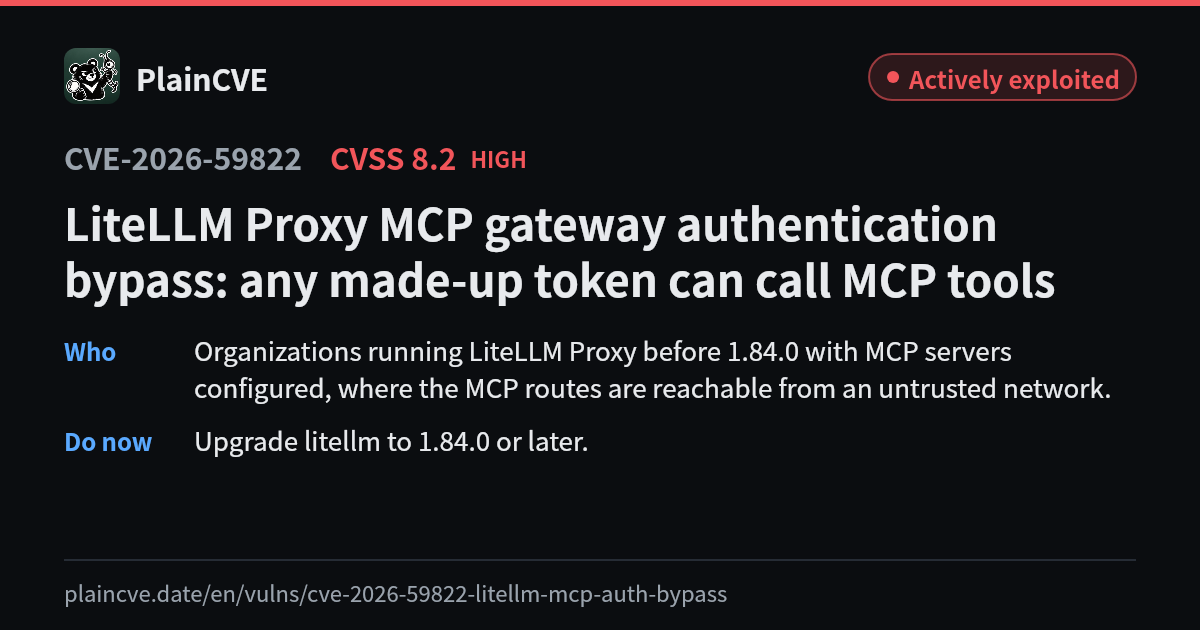
⚠ Actively exploited · CVE-2026-59822
LiteLLM Proxy's MCP endpoints let failed logins through as anonymous, so anyone can list and call its MCP tools with no account. Exploited in the wild.
What to do: Upgrade litellm to 1.84.0 or later.
https://plaincve.date/en/vulns/cve-2026-59822-litellm-mcp-auth-bypass
⚠ Actively exploited · CVE-2026-59822
LiteLLM Proxy's MCP endpoints let failed logins through as anonymous, so anyone can list and call its MCP tools with no account. Exploited in the wild.

Who is affected: Organizations running LiteLLM Proxy before 1.84.0 with MCP servers configured, where the MCP routes are reachable from an untrusted network.
What to do: Upgrade litellm to 1.84.0 or later.

https://plaincve.date/en/vulns/cve-2026-59822-litellm-mcp-auth-bypass
“Open” starts a new post on that platform in a new tab with the text filled in. We don’t track whether you share.
Press brief
In one sentence
LiteLLM is an open-source gateway that many companies use to manage their AI model calls in one place. Its MCP feature, which connects to external tools, had an authentication flaw: requests that failed verification were let through as if they were legitimate. The US agency CISA added it to its Known Exploited Vulnerabilities catalog on September 2, 2026. The fixed version, 1.84.0, was released in May.
Key facts
- Severity
- CVSS 3.1 8.2 (NVD) nvd.nist.gov
- Added to CISA KEV
- 2026-09-02 cisa.gov
- Fixed version
- 1.84.0 (released 2026-05-14) github.com
- Advisory published
- 2026-06-30 github.com
Confirmed
- Requests that fail authentication are let through as an anonymous identity on the MCP endpoints of LiteLLM Proxy before 1.84.0.
- CISA has added it to the Known Exploited Vulnerabilities catalog.
- Wiz's honeypot research observed real attack traffic against AI infrastructure.
Unconfirmed / disputed
- Some news reports call this the first MCP-related flaw in KEV; CISA itself has not said so.
- The official advisory does not say upstream model provider API keys can be read, and this page does not assume it.
Quotable line
The problem with this vulnerability isn't a weak password. It's that when the lock broke, the door was left open instead of locked.
Images
Download the share image (PNG) · Attack flow diagram (downloadable)
Please credit "PlainCVE" and link to this page. Full citation format is under "How to cite" below. Found a factual error? Report it.
LiteLLM Proxy MCP gateway authentication bypass: any made-up token can call MCP tools

LiteLLM is an open-source gateway that many companies use to manage their AI model calls in one place. Its MCP feature, which connects to external tools, had an authentication flaw: requests that failed verification were let through as if they were legitimate. The US agency CISA added it to its Known Exploited Vulnerabilities catalog on September 2, 2026. The fixed version, 1.84.0, was released in May.

Key facts:
- Severity:CVSS 3.1 8.2 (NVD)(https://nvd.nist.gov/vuln/detail/CVE-2026-59822)
- Added to CISA KEV:2026-09-02(https://www.cisa.gov/news-events/alerts/2026/09/02/cisa-adds-seven-known-exploited-vulnerabilities-catalog)
- Fixed version:1.84.0 (released 2026-05-14)(https://github.com/BerriAI/litellm/releases/tag/v1.84.0)
- Advisory published:2026-06-30(https://github.com/BerriAI/litellm/security/advisories/GHSA-7488-6r32-c95q)

Confirmed:
- Requests that fail authentication are let through as an anonymous identity on the MCP endpoints of LiteLLM Proxy before 1.84.0.
- CISA has added it to the Known Exploited Vulnerabilities catalog.
- Wiz's honeypot research observed real attack traffic against AI infrastructure.

Unconfirmed / disputed:
- Some news reports call this the first MCP-related flaw in KEV; CISA itself has not said so.
- The official advisory does not say upstream model provider API keys can be read, and this page does not assume it.

「The problem with this vulnerability isn't a weak password. It's that when the lock broke, the door was left open instead of locked.」— PlainCVE
https://plaincve.date/en/vulns/cve-2026-59822-litellm-mcp-auth-bypass
How to cite this page
This article is CC BY 4.0. Please keep the attribution and link when republishing.
PlainCVE Team (2026). "LiteLLM Proxy MCP gateway authentication bypass: any made-up token can call MCP tools". PlainCVE. https://plaincve.date/en/vulns/cve-2026-59822-litellm-mcp-auth-bypass (accessed YYYY-MM-DD)BibTeX
@misc{cve202659822litellmmcpauthbypass2026,
  title  = {LiteLLM Proxy MCP gateway authentication bypass: any made-up token can call MCP tools},
  author = {PlainCVE Team},
  year   = {2026},
  howpublished = {PlainCVE},
  url    = {https://plaincve.date/en/vulns/cve-2026-59822-litellm-mcp-auth-bypass},
  note   = {Updated 2026-09-24}
}