
// threat brief
AhsayCBS backup server Replication Receiver OS command injection: remote command execution on the server, exploited in the wild
- CVSS
- 9.3 CRITICAL
- CISA KEV
- 2026-10-14
- Weakness
- CWE-77 · CWE-78
- Topics
- Infrastructure · Web apps
AI review 2026-10-21 (not human-reviewed)Command tests: none yetReproduced: not yetVerification record ↓
AhsayCBS backup server's Replication Receiver can be abused to run OS commands remotely; exploited in the wild and listed in CISA KEV.
| Who is affected | Organizations running their own AhsayCBS backup server whose management web service is reachable over the network. Sources disagree on affected versions: the vendor says v7, v8, v9 and v10 are affected until hotfix v9.15.2.70 / v10.3.4.45 is applied. |
|---|---|
| What happens | A remote attacker could run operating system commands on the server. Huntress says that on Windows hosts this works without authentication and runs as NT AUTHORITY/SYSTEM; in real attacks a JSP webshell was planted. |
| What to do now | On v10, apply the vendor's hotfix v10.3.4.45; on v9, apply v9.15.2.70; on v7 or v8, first upgrade to v9.15.0.0 and then apply v9.15.2.70, then reboot. For compromised servers, the vendor strongly recommends a full rebuild. |
| Affected versions | Sources disagree. CVE record (VulDB): up to 10.3.2 (lists 10.3.0, 10.3.1, 10.3.2). Vendor: v10 below v10.3.4.45 and v9 below v9.15.2.70; v7 and v8 are affected too. Huntress: up to and including 10.3.4. |
| Fixed versions | Vendor's latest statement: hotfix v10.3.4.45 (v10) and v9.15.2.70 (v7–v9). The CVE record's 10.3.4 was later said by the vendor not to fully fix the issue. |
| CVSS vector | Show full vectorCVSS:4.0/AV:N/AC:L/AT:N/PR:N/UI:N/VC:H/VI:H/VA:H/SC:H/SI:H/SA:H/E:P |
| Timeline |
|
| CISA KEV | Listed (2026-10-14): attacks have been seen in the wild |
Blue team playbook
Check, fix / mitigate, respond, harden. Matching the affected versions does not mean you were compromised, and a check that finds nothing does not prove you are safe; each item says what it can and cannot show. Tagged steps point to where the attack flow below can be stopped.
- 01Check your version and exposure
Check the version in the AhsayCBS management interface. Per the vendor, v10 below v10.3.4.45, v9 below v9.15.2.70, and all v7 and v8 need action. Servers whose management web service is reachable from outside are most at risk (Bitdefender).
- 02Look for unauthorized RPS receivers
One sign of compromise the vendor lists: RPS (replication) receivers you did not add.
- 03Search the webapps folder for randomly named .jsp files
The vendor says multiple randomly named .jsp files may appear in %CBS%\webapps. Run in PowerShell on the AhsayCBS Windows server, replacing <CBS_INSTALL_DIR> with your install folder; read-only. The command below is PlainCVE's own wording, not provided by the vendor.
Read-only checkGet-ChildItem -Path "<CBS_INSTALL_DIR>\webapps" -Recurse -Filter *.jsp | Sort-Object LastWriteTime -Descending | Select-Object FullName, LastWriteTime
- 01Apply the vendor hotfix and reboot
v10: v10.3.4.45. v9: v9.15.2.70. v7 and v8: upgrade to v9.15.0.0 first, then apply v9.15.2.70. Reboot afterwards. The hotfixes require a partner portal login.
- 02Restrict access to the management interface (Huntress recommendation)
Huntress recommends allowing only trusted IP addresses or requiring a VPN.
- 01If compromised: rebuild the backup server
The vendor strongly recommends a full rebuild of a compromised backup server. Patching alone does not remove an existing compromise, such as a planted webshell.
- 01Don't expose the backup server's management interface to the internet
Following Huntress's recommendation and Bitdefender's analysis, servers reachable only internally or over VPN are less exposed.
- 02Keep following vendor announcements (PlainCVE suggestion)
The vendor's statement on which version is fixed changed several times within days; rely on the latest vendor announcement rather than the CVE record alone.
Full remediation steps and notes
| Current version | Vendor instruction |
|---|---|
| v10 (including 10.3.4 / v10.3.4.0) | Apply hotfix v10.3.4.45 |
| v9 (including v9.15.2.59) | Apply hotfix v9.15.2.70 |
| v8, v7 | Upgrade to v9.15.0.0 first, then apply v9.15.2.70 |
- Order: reboot after applying the hotfix (vendor instruction). The hotfixes require a partner portal login to download.
- About the fix’s scope: the vendor says both hotfixes fully address CVE-2026-105133 and CVE-2026-105134. Huntress describes 10.3.4.45 as fixing 105133 (the authentication bypass), which blocks the path to 105134; whether the command injection itself was fixed is not independently confirmed, and we have seen no independent check of v9.15.2.70. So even after patching, it is worth restricting management access as Huntress recommends.
- Patching does not remove an existing compromise. If you find the vendor’s signs of compromise, the vendor strongly recommends a full rebuild of the backup server.
Attack flow
Read left to right: this is the order the attack happens in. A blue shield means the step can be stopped; the earlier, the better. Click an icon for details.
Read top to bottom: this is the order the attack happens in. A blue shield means the step can be stopped; the earlier, the better. Tap an icon for details.
- Attacker
Reaches the AhsayCBS management web service over the network
The CVE record says the attack can be launched remotely. Bitdefender notes that servers reachable only from internal networks are less exposed.
Defense: Huntress recommends limiting the management interface to trusted IP addresses or requiring a VPN.
- Attacker
In observed attacks, first uses CVE-2026-105133 to bypass authentication
That is a separate authentication flaw. Bitdefender notes NVD scores this flaw as needing no privileges, so an attacker may not need the full chain; whether the bypass is required is unconfirmed.
Defense: Apply the vendor hotfix v10.3.4.45 / v9.15.2.70. Huntress independently verified that 10.3.4.45 blocks this entry point.
- Your system
The Replication Receiver's UpdateReceivers.do passes a parameter into an OS command
Manipulating one of the endpoint's parameters leads to command injection. Huntress says commands run as NT AUTHORITY/SYSTEM on Windows hosts.
Defense: The vendor says both hotfixes fully address CVE-2026-105133 and CVE-2026-105134.
- Attacker
Sets up a malicious replication receiver and drops a JSP webshell
Huntress observed attackers setting up a malicious replication receiver and placing a JSP webshell in the directory the application serves.
Defense: Check the vendor's signs of compromise: unauthorized RPS receivers and randomly named .jsp files in %CBS%\webapps.
Who is affected
AhsayCBS is Ahsay’s backup server software. You need to care only if you run AhsayCBS yourself and its management web service is reachable over the network; Bitdefender notes that servers reachable only from internal networks are less exposed.
Sources disagree on the affected versions:
| Source | Affected | Fixed |
|---|---|---|
| CVE record (CNA: VulDB; repeated by NVD, GitHub, INCIBE, OpenCVE) | Up to 10.3.2 (lists 10.3.0, 10.3.1, 10.3.2) | 10.3.4 |
| Ahsay (latest statements, Oct 12–13) | v10 below v10.3.4.45, v9 below v9.15.2.70; v7 and v8 affected too | Hotfixes v10.3.4.45 and v9.15.2.70 |
| Huntress (researcher) | Up to and including 10.3.4 | Huntress verified 10.3.4.45 blocks the entry point |
| BleepingComputer (news) | — | Says “fixed in 10.3.2”, which contradicts the CVE record listing 10.3.2 as affected; it looks like a reporting error |
PlainCVE follows the vendor’s latest statement: v10 is fixed only at v10.3.4.45, and v9 only at v9.15.2.70. Servers already on 10.3.4 / v10.3.4.0 are still affected.
How it works
AhsayCBS has a “Replication Receiver” component that receives backups replicated from other servers. According to the CVE record, its /rps/api/json/UpdateReceivers.do endpoint puts the contents of one parameter into an operating system command; by manipulating that parameter, an attacker can make the server run extra commands of their own. This is called OS command injection; CISA KEV maps it to CWE-77 and CWE-78. PlainCVE has not seen the vulnerable source code.
The flawed approach (conceptual illustration of command injection in general, not AhsayCBS source code):
Show code example(text)
cmd = "some-tool --option " + request.param   # outside input glued into a command string
run_in_shell(cmd)                              # the shell parses it, so smuggled commands run too
The safe approach:
Show code example(text)
value = validate_strictly(request.param)       # accept only the expected format, reject the rest
run_program(["some-tool", "--option", value])  # run with an argument list, no shell parsing
Impact. CISA says a remote attacker could run operating system commands. Huntress says that on Windows hosts this works without authentication and runs as NT AUTHORITY/SYSTEM (the highest system privilege).
Chained with CVE-2026-105133. This flaw can be chained with a separate authentication flaw, CVE-2026-105133. In the attacks observed, attackers used 105133 first to bypass login. However, the NVD CVSS 3.1 vector scores this flaw as needing no privileges (PR:N) and no user interaction (UI:N), so Bitdefender notes an attacker may not need the full chain. Whether the authentication bypass is required is not confirmed.
Exploitation. The CVE record says an exploit has been published (we do not link it). Huntress observed real attacks starting 2026-10-07 23:20:15 UTC: attackers set up a malicious replication receiver and placed a JSP webshell (a small program that gives remote control of the server) in the directory the application serves; five organizations had been targeted as of October 8. CISA added it to KEV on 2026-10-14 with a federal deadline of 2026-10-17; CISA lists use in ransomware campaigns as “Unknown”.
Timeline
| Date | Event |
|---|---|
| 2026-08-04 / 08-05 | AhsayCBS 10.3.4 released (the announcement says August 4, the release notes say 05-Aug-2026); the release notes mention no security fix |
| 2026-10-03 | The CVE record’s (VulDB) timeline lists “Advisory disclosed” (and VulDB entry created); we could not read that content, so first publication is still taken as the CVE publish date, 10-04 |
| 2026-10-04 | CVE published |
| 2026-10-07 23:20:15 UTC | Huntress begins observing exploitation in the wild |
| 2026-10-08 | Huntress counts five organizations targeted |
| 2026-10-09 | Ahsay starts receiving partner reports of unauthorized access; the same day it says v10.3.4.0 is fixed (withdrawn on the 10th and 12th) |
| 2026-10-10 | Vendor says hotfix v10.3.4.45 released (Huntress and Bitdefender say October 12; sources disagree) |
| 2026-10-12 | Vendor releases hotfix v9.15.2.70 and admits earlier patches v9.15.2.59 and v10.3.4.0 were incomplete |
| 2026-10-13 | Vendor’s latest statement: both hotfixes fully address both CVEs |
| 2026-10-14 | CISA adds it to KEV (federal deadline 2026-10-17) |
Further reading
- Scoring differences. CVSS 4.0: NVD, INCIBE and news reports give 9.3, while the CVE record (as shown by OpenCVE) gives 10 for the same vector. CVSS 3.1: VulDB (the CNA) gives 10.0 (as reported by Bitdefender); the NVD record shows the vector
AV:N/AC:L/PR:N/UI:N/S:C/C:H/I:H/A:H. This page uses 9.3. - Zero-day? The Hacker News called the flaws effectively zero-days because 10.3.4, believed to be fixed, was still vulnerable when attacks began; that is a news outlet’s description, not a vendor or CISA finding. Our analysis: exploitation began on October 7, and the first hotfix the vendor calls effective (v10.3.4.45) came out on October 10, so attacks appear to have started before a complete fix existed; however, v10.3.4.0, which the vendor had claimed was a fix, had been out since August.
- When the flaw was introduced. The available sources do not say.
- Related vulnerability: CVE-2026-105133 (authentication bypass). Related weakness types: CWE-77, CWE-78.
Verification Checked item by item against sources by AI under our review rules, all passed; not human-reviewed and not yet reproduced in our lab
| AI review | 2026-10-21 · review rules |
|---|
Verification records describe the environment and the result only, never reproduction steps or code that could attack other people’s systems. See our policy.
Sources
- CVE / NVD / OSVCVE-2026-105134 record (CVE Services API) · CVE Program (CNA: VulDB), 2026-10-04 · accessed 2026-10-20
- CVE / NVD / OSVNVD API - CVE-2026-105134 · NIST · accessed 2026-10-20
- AdvisoryPatch update for CVE-2026-105133 and CVE-2026-105134 · Ahsay, 2026-10-12 · accessed 2026-10-20
- AdvisoryAhsay company announcements · Ahsay · accessed 2026-10-20
- VendorAhsayCBS (DIY) v10.3.4 Release Notes · Ahsay, 2026-08-05 · accessed 2026-10-20
- ResearchAhsayCBS flaws exploited · Huntress · accessed 2026-10-20
- ResearchTechnical Advisory: AhsayCBS exploitation chain (CVE-2026-105133, CVE-2026-105134) · Bitdefender · accessed 2026-10-20
- OtherCVE-2026-105134 · OpenCVE · accessed 2026-10-20
- NewsAttackers exploit AhsayCBS flaws · The Hacker News · accessed 2026-10-20
- NewsUnpatched AhsayCBS flaws exploited to deploy webshells, mine crypto · BleepingComputer · accessed 2026-10-20
Share this page (X / Threads)
The post text comes straight from this page’s summary. When you paste the link, X and Threads show this image automatically.
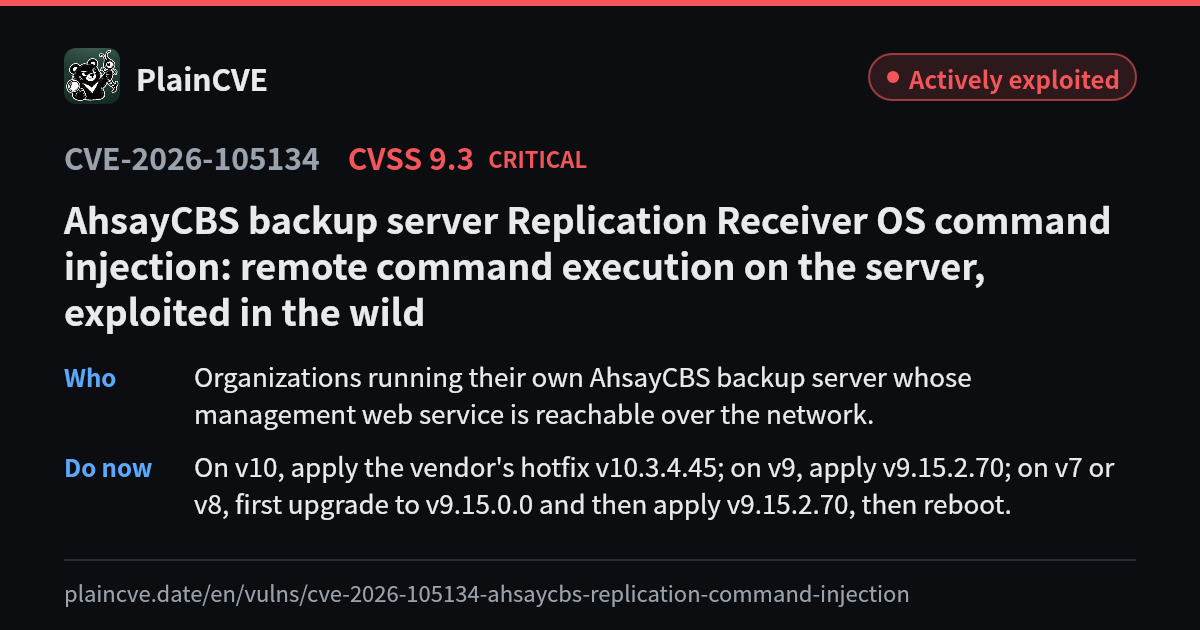
⚠ Actively exploited · CVE-2026-105134
AhsayCBS backup server's Replication Receiver can be abused to run OS commands remotely; exploited in the wild and listed in CISA KEV.
https://plaincve.date/en/vulns/cve-2026-105134-ahsaycbs-replication-command-injection
⚠ Actively exploited · CVE-2026-105134
AhsayCBS backup server's Replication Receiver can be abused to run OS commands remotely; exploited in the wild and listed in CISA KEV.

What to do: On v10, apply the vendor's hotfix v10.3.4.45; on v9, apply v9.15.2.70; on v7 or v8, first upgrade to v9.15.0.0 and then apply v9.15.2.70, then reboot.

https://plaincve.date/en/vulns/cve-2026-105134-ahsaycbs-replication-command-injection
“Open” starts a new post on that platform in a new tab with the text filled in. We don’t track whether you share.
Press brief
In one sentence
AhsayCBS is backup server software. A command injection flaw in its Replication Receiver component could let a remote attacker run operating system commands on the server. Security firm Huntress observed attacks starting October 7, 2026, and the US agency CISA added the flaw to its Known Exploited Vulnerabilities catalog on October 14. The vendor's earlier patches were incomplete; the current fixes are hotfixes v10.3.4.45 and v9.15.2.70.
Key facts
- CVE published
- 2026-10-04 cveawg.mitre.org
- First exploitation observed (Huntress)
- 2026-10-07 23:20:15 UTC huntress.com
- Severity
- CVSS v4 9.3 (as reported by The Hacker News) thehackernews.com
- Vendor hotfixes
- v10.3.4.45 (v10), v9.15.2.70 (v7–v9) ahsay.com
Confirmed
- The Replication Receiver's UpdateReceivers.do has an OS command injection that can be triggered remotely.
- CISA added it to the Known Exploited Vulnerabilities catalog (2026-10-14).
- Huntress observed real attacks in which a JSP webshell was planted; five organizations had been targeted as of October 8.
- The vendor admitted its earlier v10.3.4.0 and v9.15.2.59 patches were incomplete.
Unconfirmed / disputed
- Sources disagree on affected and fixed versions (CVE record, vendor, Huntress, news).
- Whether exploiting this flaw requires first bypassing authentication (CVE-2026-105133) is unconfirmed.
- Huntress describes the hotfix as fixing the authentication bypass; whether the command injection itself was fixed is not independently confirmed, and v9.15.2.70 has not been independently checked.
- Use in ransomware campaigns: CISA lists it as "Unknown".
Quotable line
The most dangerous part wasn't only the flaw itself, but the words "already fixed" being said too early.
Images
Download the share image (PNG) · Attack flow diagram (downloadable)
Please credit "PlainCVE" and link to this page. Full citation format is under "How to cite" below. Found a factual error? Report it.
AhsayCBS backup server Replication Receiver OS command injection: remote command execution on the server, exploited in the wild

AhsayCBS is backup server software. A command injection flaw in its Replication Receiver component could let a remote attacker run operating system commands on the server. Security firm Huntress observed attacks starting October 7, 2026, and the US agency CISA added the flaw to its Known Exploited Vulnerabilities catalog on October 14. The vendor's earlier patches were incomplete; the current fixes are hotfixes v10.3.4.45 and v9.15.2.70.

Key facts:
- CVE published:2026-10-04(https://cveawg.mitre.org/api/cve/CVE-2026-105134)
- First exploitation observed (Huntress):2026-10-07 23:20:15 UTC(https://www.huntress.com/blog/ahsaycbs-flaws-exploit)
- Severity:CVSS v4 9.3 (as reported by The Hacker News)(https://thehackernews.com/2026/10/attackers-exploit-ahsaycbs-flaws-to.html)
- Vendor hotfixes:v10.3.4.45 (v10), v9.15.2.70 (v7–v9)(https://www.ahsay.com/en/company/announcements/patch-cve-105133-105134-update)

Confirmed:
- The Replication Receiver's UpdateReceivers.do has an OS command injection that can be triggered remotely.
- CISA added it to the Known Exploited Vulnerabilities catalog (2026-10-14).
- Huntress observed real attacks in which a JSP webshell was planted; five organizations had been targeted as of October 8.
- The vendor admitted its earlier v10.3.4.0 and v9.15.2.59 patches were incomplete.

Unconfirmed / disputed:
- Sources disagree on affected and fixed versions (CVE record, vendor, Huntress, news).
- Whether exploiting this flaw requires first bypassing authentication (CVE-2026-105133) is unconfirmed.
- Huntress describes the hotfix as fixing the authentication bypass; whether the command injection itself was fixed is not independently confirmed, and v9.15.2.70 has not been independently checked.
- Use in ransomware campaigns: CISA lists it as "Unknown".

「The most dangerous part wasn't only the flaw itself, but the words "already fixed" being said too early.」— PlainCVE
https://plaincve.date/en/vulns/cve-2026-105134-ahsaycbs-replication-command-injection
How to cite this page
This article is CC BY 4.0. Please keep the attribution and link when republishing.
PlainCVE Team (2026). "AhsayCBS backup server Replication Receiver OS command injection: remote command execution on the server, exploited in the wild". PlainCVE. https://plaincve.date/en/vulns/cve-2026-105134-ahsaycbs-replication-command-injection (accessed YYYY-MM-DD)BibTeX
@misc{cve2026105134ahsaycbsreplicationcommandinjection2026,
  title  = {AhsayCBS backup server Replication Receiver OS command injection: remote command execution on the server, exploited in the wild},
  author = {PlainCVE Team},
  year   = {2026},
  howpublished = {PlainCVE},
  url    = {https://plaincve.date/en/vulns/cve-2026-105134-ahsaycbs-replication-command-injection},
  note   = {Updated 2026-10-21}
}