
// threat brief
FortiMail path traversal: unauthenticated attackers may be able to write arbitrary files, exploited in the wild, fixed releases listed on Oct 5
- CVSS
- 9.8 CRITICAL
- CISA KEV
- 2026-10-01
- Weakness
- CWE-22 · CWE-158
- Topics
- Infrastructure
AI review 2026-10-07 (not human-reviewed)Command tests: none yetReproduced: not yetVerification record ↓
FortiMail flaw may let unauthenticated attackers write arbitrary files via crafted web requests; exploited in the wild; Fortinet listed fixes on 2026-10-05.
| Who is affected | Two Fortinet primary sources disagree: Fortinet's advisory lists FortiMail 8.0.0–8.0.1, 7.6.0–7.6.6, 7.4.0–7.4.8 and 7.2.0–7.2.9; the CVE record Fortinet filed as CNA lists, in its structured data, 8.0.0, 7.6.0–7.6.5, 7.4.0–7.4.6, 7.2.0–7.2.9 and also 7.0.0–7.0.9. Check any version listed as affected by either source (including 7.0.0–7.0.9); see the page body. |
|---|---|
| What happens | An attacker may be able to write arbitrary files on the appliance's underlying system; Fortinet lists the impact category as executing unauthorized code or commands. |
| What to do now | Upgrade to a release both Fortinet sources treat as fixed: 8.0.2, 7.6.7 or 7.4.9 or later (the advisory says 7.2 users move to the 7.4 branch or later; PlainCVE's analysis is that this must be 7.4.9 or later, since 7.4.0–7.4.8 is itself affected; the CVE record also lists 7.0 as affected, and neither source lists a 7.0 fix, so PlainCVE suggests 7.0 users likewise move to a fixed release such as 7.4.9 or later). If you cannot upgrade right away, apply Fortinet's workarounds: disable the IBE feature, allow webmail interface access only from a trusted private network, or use a WAF to block the requests to /ibe described in the advisory. Check Fortinet's published indicators of compromise. |
| Affected versions | 8.0.0–8.0.1, 7.6.0–7.6.6, 7.4.0–7.4.8, 7.2.0–7.2.9 (Fortinet advisory); the CVE record's structured data also lists 7.0.0–7.0.9 and uses different upper bounds |
| Fixed versions | 8.0.2, 7.6.7 and 7.4.9 or later (Fortinet advisory, updated 2026-10-05); 7.2 users must move to the 7.4 branch or later (Fortinet advisory); PlainCVE's analysis: this only helps at 7.4.9 or later. The CVE record's solution field instead says 8.0.1, 7.6.6, 7.4.8, 7.2.10 or later; neither source lists a 7.0 fix |
| CVSS vector | Show full vectorCVSS:3.1/AV:N/AC:L/PR:N/UI:N/S:U/C:H/I:H/A:H |
| Timeline |
|
| CISA KEV | Listed (2026-10-01): attacks have been seen in the wild |
Blue team playbook
Check, fix / mitigate, respond, harden. Matching the affected versions does not mean you were compromised, and a check that finds nothing does not prove you are safe; each item says what it can and cannot show. Tagged steps point to where the attack flow below can be stopped.
- 01Check your version against both Fortinet sources
Fortinet's advisory lists 8.0.0–8.0.1, 7.6.0–7.6.6, 7.4.0–7.4.8, 7.2.0–7.2.9; the CVE record Fortinet filed also lists 7.0.0–7.0.9 in its structured data. PlainCVE's suggestion: treat any version in either range (7.0.0–7.0.9, 7.2.0–7.2.9, 7.4.0–7.4.8, 7.6.0–7.6.6, 8.0.0–8.0.1) as needing action. NVD's own CPE configuration matches the advisory and does not include 7.0. Suped warns that the CVE record's machine-readable version data conflicts with the advisory, so relying only on a scanner or cached feed can lead to the wrong decision.
- 02Check for Fortinet's indicators of compromise
Fortinet's current advisory lists IP addresses tied to the attacks (79.141.169.187, 45.129.0.192) and sample System Event Log and Encryption Log entries. Use the full list in the advisory.
Read-only checkgrep -E '79\.141\.169\.187|45\.129\.0\.192' exported-fortimail-logs.txt
- 01Disable the IBE feature (official workaround)
If you cannot upgrade right away, Fortinet's workaround is to disable IBE feature support from the GUI or CLI; see the advisory for the exact steps.
- 02Restrict webmail interface access or filter with a WAF (official alternative)
Fortinet's alternatives: block internet access to the FortiMail webmail interface, or allow access only from a trusted private network; or use a WAF to block the POST requests to /ibe described in the advisory. PlainCVE's analysis: restricting only the management interface may leave the webmail interface exposed (Fortinet's advisory does not say this).
- 03Upgrade to a fixed release
Fortinet's advisory (updated 2026-10-05) lists 8.0.2, 7.6.7 and 7.4.9 or later, which both Fortinet sources treat as fixed. 7.2 users must move to the 7.4 branch or later; our analysis is that this only helps at 7.4.9 or later. The CVE record also lists 7.0.0–7.0.9 as affected, but neither source lists a 7.0 fix; PlainCVE's suggestion is that 7.0 users move to a release both sources treat as fixed (for example 7.4.9 or later). For FortiMail Cloud, two Fortinet primary sources differ. Fortinet's advisory (2026-10-07 clarification) says the cloud firmware was updated to 7.6.7 GA or 8.0.2 GA on 10-05, while the solution field of the CVE record Fortinet filed (updated 2026-10-07) says the issue was remediated in FortiMail Cloud version 25.1 (not released). Both say cloud customers need not take action.
- 01Treat a device with indicators as possibly compromised
PlainCVE's suggestion: preserve logs and investigate against the full indicator list in the advisory. The sources behind this page do not describe official cleanup steps. Suped notes that file write does not prove code ran on every device, but that is no reason to assume a device is clean.
- 01Keep unneeded web interfaces off the internet
PlainCVE's suggestion: Fortinet's alternative workaround here is to restrict the webmail interface; exposing only the web interfaces you need (including webmail and management) long term shrinks exposure to similar flaws.
- 02Check both the vendor advisory and the CVE record
Suped points out that machine-readable CVE data can differ from the vendor advisory. PlainCVE's suggestion: check inventory against both the vendor advisory and the CVE record, and act on any version either one lists as affected.
Full remediation steps and notes
Fortinet’s advisory (updated 2026-10-05) now lists fixed releases: upgrade to 8.0.2, 7.6.7 or 7.4.9 or later, and check for indicators of compromise. If you cannot upgrade right away, apply a workaround first:
- Disabling IBE: Fortinet’s advisory gives GUI and CLI ways to do this; take them directly from the advisory.
- Restrict the webmail interface: block internet access to the webmail interface, or allow it only from a trusted private network (Fortinet). PlainCVE’s analysis: restricting only the management interface is not enough (Fortinet’s advisory does not say this).
- WAF: use a WAF to block the POST requests to /ibe described in the advisory (Fortinet).
- 7.2 users: Fortinet says to move to the 7.4 branch or later, but 7.4.0–7.4.8 is itself affected. Our analysis (Suped makes the same point): moving from 7.2 to 7.4 only helps at 7.4.9 or later.
- 7.0 users: the CVE record lists 7.0.0–7.0.9 as affected, the advisory does not; neither source lists a 7.0 fix. PlainCVE’s suggestion: 7.0 users should check too and move to a release both sources treat as fixed (for example 7.4.9 or later).
- FortiMail Cloud: two Fortinet primary sources differ. Fortinet’s advisory (2026-10-07 clarification) says the cloud firmware was updated to 7.6.7 GA or 8.0.2 GA on 10-05; the solution field of the CVE record Fortinet filed (updated 2026-10-07) says “Fortinet remediated this issue in FortiMail Cloud version 25.1 (not released)”. Both say cloud customers need not take action.
- The CVE record’s fix guidance differs from the advisory:
| Branch | CVE record solution text | Fortinet advisory |
|---|---|---|
| 8.0 | 8.0.1 or later | 8.0.1 is affected; fix is 8.0.2 |
| 7.6 | 7.6.6 or later | 7.6.6 is affected; fix is 7.6.7 |
| 7.4 | 7.4.8 or later | 7.4.8 is affected; fix is 7.4.9 |
| 7.2 | Upcoming 7.2.10 | Move to the 7.4 branch |
The releases both sources treat as fixed are 8.0.2, 7.6.7 and 7.4.9 or later; 8.0.1, 7.6.6 and 7.4.8, named in the CVE record, are still listed as affected in the advisory, so PlainCVE suggests not stopping at those. The CVE record’s solution text also mentions FortiRecorder versions, but no FortiRecorder product is listed as affected; whether FortiRecorder is affected is unconfirmed and may be a copy error.
Attack flow
Read left to right: this is the order the attack happens in. A blue shield means the step can be stopped; the earlier, the better. Click an icon for details.
Read top to bottom: this is the order the attack happens in. A blue shield means the step can be stopped; the earlier, the better. Tap an icon for details.
- Attacker
Sends crafted HTTP/HTTPS requests to FortiMail
No login is needed. Fortinet's workarounds target the webmail interface and the /ibe endpoint, indicating the attacker must be able to reach that interface (BleepingComputer, quoting the advisory as first published, says management interface; the current advisory says webmail interface).
Defense: One of Fortinet's workarounds: block internet access to the webmail interface, or allow it only from a trusted private network; or use a WAF to block the POST requests to /ibe described in the advisory.
- Your system
The appliance fails to keep the file path inside the allowed folder
The weakness is path traversal (CWE-22) combined with improper handling of NULL bytes (CWE-158). Third-party analysis (hol.org) says the vulnerable component backs IBE (Identity Based Encryption); Fortinet does not explicitly say IBE must be enabled.
Defense: Upgrade to the fixed releases listed by Fortinet (8.0.2, 7.6.7, 7.4.9 or later); workaround: disable IBE feature support from the GUI or CLI.
- Your system
The attacker writes arbitrary files on the underlying system
Arbitrary file write is the impact Fortinet describes; the current advisory does not list specific files written.
Defense: Check for the IP addresses and sample log entries (System Event Logs, Encryption Logs) in Fortinet's advisory.
- Attacker
May go on to run unauthorized code or commands
Fortinet lists the impact category as executing unauthorized code or commands. Suped cautions that file write alone does not prove code ran on every target.
Who is affected
FortiMail is Fortinet’s email security appliance. Two Fortinet primary sources disagree on the affected versions; the table lists both with their sources:
| Branch | Affected (Fortinet advisory FG-IR-26-175) | Affected (structured data in the CVE record Fortinet filed) | Fixed (Fortinet advisory) |
|---|---|---|---|
| 8.0 | 8.0.0–8.0.1 | 8.0.0 | 8.0.2 or later |
| 7.6 | 7.6.0–7.6.6 | 7.6.0–7.6.5 | 7.6.7 or later |
| 7.4 | 7.4.0–7.4.8 | 7.4.0–7.4.6 | 7.4.9 or later |
| 7.2 | 7.2.0–7.2.9 | 7.2.0–7.2.9 | No 7.2 fix listed; move to the 7.4 branch or later |
| 7.0 | Not listed | 7.0.0–7.0.9 | Neither source lists a 7.0 fix |
The fixed versions follow Fortinet’s 2026-10-05 “Solution update” to the advisory; Fortinet’s documentation site also has release notes for 8.0.2, 7.6.7 and 7.4.9 (dated 2026-10-05). BleepingComputer reported, when the advisory first came out, that no security updates were available yet for 7.4, 7.6 and 8.0; that is no longer current.
The sources disagree. The machine-readable version data in the CVE record (filed by Fortinet as CNA; still the case after its 2026-10-07 update) does not match Fortinet’s advisory: it also marks 7.0.0–7.0.9 as affected (neither the advisory nor the CVE text mentions 7.0), ends 7.4 at 7.4.6 and 7.6 at 7.6.5, and lists only 8.0.0 for 8.0. NVD’s own CPE configuration matches the advisory (7.2.0–7.4.8, 7.6.0–7.6.6, 8.0.0–8.0.1) and does not include 7.0. Suped points this out too and warns that an inventory based only on a scanner or cached feed can lead to the wrong remediation decision. PlainCVE’s suggestion: treat any version in either source’s range (including 7.0.0–7.0.9) as needing action.
Preconditions: no login is needed (Fortinet); the attacker must be able to send HTTP/HTTPS requests to the appliance (Fortinet); Fortinet’s current advisory’s workarounds target the webmail interface and POST requests to /ibe (BleepingComputer, quoting the advisory as first published, says management interface; the current advisory says webmail interface). Third-party analysis (hol.org) says the vulnerable component backs IBE (Identity Based Encryption), and Fortinet’s “disable IBE” workaround points the same way, but Fortinet does not explicitly say IBE must be enabled for a device to be vulnerable.
How it works
Fortinet describes the weakness as a combination of two problems: path traversal (CWE-22, failing to keep a file path inside the allowed folder) and improper handling of NULL bytes (CWE-158). A NULL byte is a special character many programs treat as “the string ends here”; if the code that checks a filename and the code that writes the file interpret it differently, the check can be bypassed. Fortinet has not published the specific faulty code; the example below only illustrates this class of flaw in general.
The flawed approach (conceptual illustration, not FortiMail code):
Show code example(python)
name = request_filename            # comes from the outside request
path = BASE_DIR + "/" + name       # joined directly, no check for ".." or NULL bytes
write_file(path, data)
The fixed approach:
Show code example(python)
if "\x00" in name:
    reject()
path = os.path.realpath(os.path.join(BASE_DIR, name))
if not path.startswith(os.path.realpath(BASE_DIR) + os.sep):
    reject()                        # after resolving, it must still be inside the allowed folder
write_file(path, data)
The result is that an attacker may be able to write arbitrary files on the appliance’s underlying system. Fortinet lists the impact category as executing unauthorized code or commands, and the CVSS 3.1 score is 9.8. Suped cautions that arbitrary file write is a serious integrity risk but does not by itself prove that every exposed appliance was compromised or had code run on it.
Timeline
| Date | Event |
|---|---|
| Unknown | When attacks began has not been disclosed |
| 2026-10-01 | Fortinet publishes advisory FG-IR-26-175, saying the flaw has been reported exploited in the wild |
| 2026-10-01 | CVE record published (19:17 UTC) |
| 2026-10-01 | CISA adds it to the Known Exploited Vulnerabilities (KEV) catalog |
| 2026-10-04 | KEV remediation due date for US federal agencies |
| 2026-10-05 | Fortinet updates the advisory’s solution (“Solution update”), listing fixed releases 8.0.2, 7.6.7 and 7.4.9 or later |
| 2026-10-07 | Fortinet adds a clarification to the advisory that FortiMail Cloud was updated to 7.6.7 GA or 8.0.2 GA on 10-05 and customers need not take action; the CVE record is updated the same day, its structured data still lists 7.0.0–7.0.9, and its solution field says FortiMail Cloud was remediated in version 25.1 (not released), with no customer action needed |
Further reading
- Scoring: CVSS 3.1 9.8 (AV:N/AC:L/PR:N/UI:N/S:U/C:H/I:H/A:H), supplied by Fortinet PSIRT and shown in NVD.
- “Zero-day” is BleepingComputer’s term; Fortinet’s advisory does not use it. BleepingComputer and Suped reported that fixes were still “upcoming” when the advisory first came out; the current advisory was revised on 10-05, so the original text cannot be confirmed at the source.
- Fortinet has not disclosed when attacks began, how many systems were compromised or who is behind them; KEV lists known ransomware use as “Unknown”.
- The flaw was found internally by Fortinet’s Product Security team.
- The sources do not say which version or code change introduced the flaw.
- Related weakness types: CWE-22, CWE-158.
Verification Checked item by item against sources by AI under our review rules, all passed; not human-reviewed and not yet reproduced in our lab
| AI review | 2026-10-07 · review rules |
|---|
Verification records describe the environment and the result only, never reproduction steps or code that could attack other people’s systems. See our policy.
Sources
- AdvisoryFG-IR-26-175 — FortiMail path traversal and NULL byte vulnerability · Fortinet PSIRT, 2026-10-01 · accessed 2026-10-02
- CVE / NVD / OSVCVE-2026-104286 Record (CVE API) · CVE Program, 2026-10-01 · accessed 2026-10-02
- CVE / NVD / OSVNVD API - CVE-2026-104286 · NIST · accessed 2026-10-02
- NewsFortinet warns of critical FortiMail flaw exploited in zero-day attacks · BleepingComputer · accessed 2026-10-02
- ResearchCISA flags active exploitation of FortiMail CVE-2026-104286 · Suped · accessed 2026-10-02
- ResearchCVE-2026-104286: FortiMail path traversal in KEV · hol.org · accessed 2026-10-02
Share this page (X / Threads)
The post text comes straight from this page’s summary. When you paste the link, X and Threads show this image automatically.
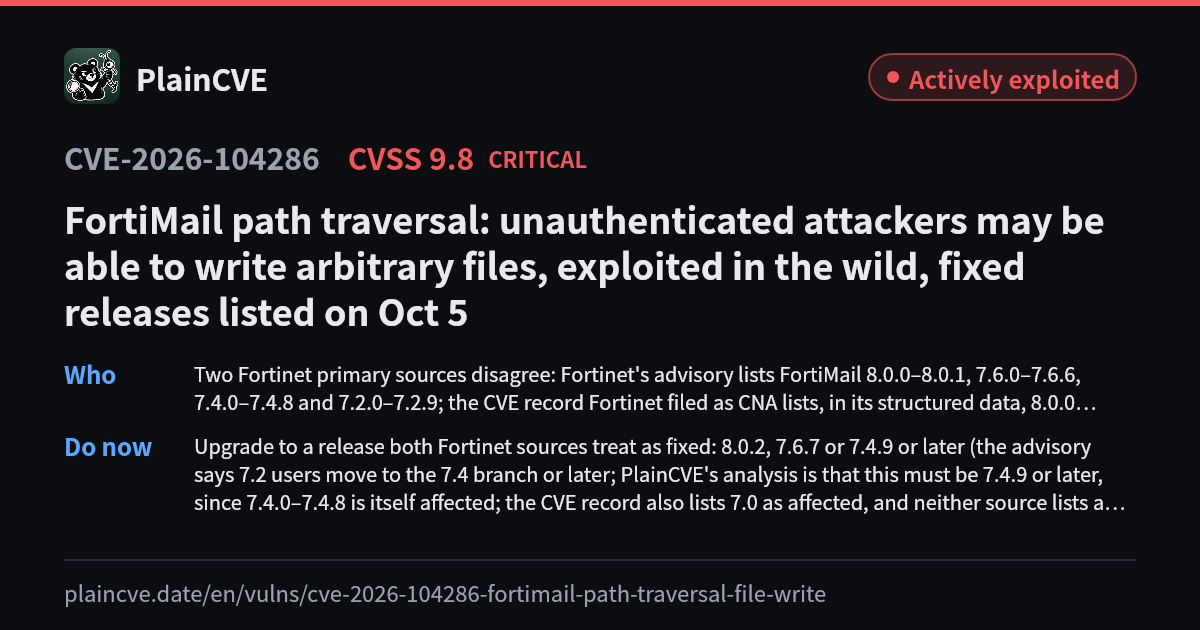
⚠ Actively exploited · CVE-2026-104286
FortiMail flaw may let unauthenticated attackers write arbitrary files via crafted web requests; exploited in the wild; Fortinet listed fixes on 2026-10-05.
https://plaincve.date/en/vulns/cve-2026-104286-fortimail-path-traversal-file-write
⚠ Actively exploited · CVE-2026-104286
FortiMail flaw may let unauthenticated attackers write arbitrary files via crafted web requests; exploited in the wild; Fortinet listed fixes on 2026-10-05.

https://plaincve.date/en/vulns/cve-2026-104286-fortimail-path-traversal-file-write
“Open” starts a new post on that platform in a new tab with the text filled in. We don’t track whether you share.
Press brief
In one sentence
FortiMail is Fortinet's email security appliance. On October 1, 2026, Fortinet disclosed a path traversal flaw (CVE-2026-104286) that may let an unauthenticated attacker write arbitrary files on the device, and said it has been reported to be exploited in the wild. The US agency CISA added it to its Known Exploited Vulnerabilities catalog the same day. On October 5, Fortinet updated the advisory to list fixed releases 8.0.2, 7.6.7 and 7.4.9 or later.
Key facts
- Severity
- CVSS 3.1 9.8 (Critical) services.nvd.nist.gov
- Fortinet advisory
- FG-IR-26-175, published 2026-10-01 fortiguard.fortinet.com
- Affected versions (Fortinet advisory)
- 8.0.0–8.0.1, 7.6.0–7.6.6, 7.4.0–7.4.8, 7.2.0–7.2.9 fortiguard.fortinet.com
- Affected versions (CVE record structured data)
- 8.0.0, 7.6.0–7.6.5, 7.4.0–7.4.6, 7.2.0–7.2.9, 7.0.0–7.0.9 cveawg.mitre.org
- Fix status
- Fixed releases listed — 8.0.2, 7.6.7, 7.4.9 or later (advisory updated 2026-10-05) fortiguard.fortinet.com
- Found by
- Fortinet Product Security team, internally fortiguard.fortinet.com
Confirmed
- Fortinet confirms an unauthenticated attacker may write arbitrary files on the device via crafted HTTP/HTTPS requests.
- Fortinet says it has been reported exploited in the wild; CISA added it to KEV on 2026-10-01.
- Fortinet updated its advisory on 2026-10-05 to list fixed releases 8.0.2, 7.6.7 and 7.4.9 or later (7.2 users move to the 7.4 branch or later).
Unconfirmed / disputed
- Whether the original October 1 advisory listed the fixes as 'upcoming': the current advisory has been revised and the original text cannot be read at the source; this claim comes from secondary reports (BleepingComputer, Suped), and the CVE record's solution field also says 'upcoming' but with different version numbers than the advisory.
- Fortinet has not disclosed when attacks began, how many systems were hit, or who is behind them; KEV lists ransomware use as 'Unknown'.
- The CVE record's version and fix data disagree with Fortinet's advisory and mention FortiRecorder; whether FortiRecorder is affected is unconfirmed.
- The term 'zero-day' comes from BleepingComputer's report; Fortinet's advisory does not use it.
- Fortinet does not explicitly say IBE must be enabled for a device to be vulnerable.
Quotable line
PlainCVE's advice: Fortinet has listed fixed releases, so upgrade soon; if you cannot upgrade right away, follow the advisory to disable IBE, restrict webmail interface access, or filter with a WAF.
Images
Download the share image (PNG) · Attack flow diagram (downloadable)
Please credit "PlainCVE" and link to this page. Full citation format is under "How to cite" below. Found a factual error? Report it.
FortiMail path traversal: unauthenticated attackers may be able to write arbitrary files, exploited in the wild, fixed releases listed on Oct 5

FortiMail is Fortinet's email security appliance. On October 1, 2026, Fortinet disclosed a path traversal flaw (CVE-2026-104286) that may let an unauthenticated attacker write arbitrary files on the device, and said it has been reported to be exploited in the wild. The US agency CISA added it to its Known Exploited Vulnerabilities catalog the same day. On October 5, Fortinet updated the advisory to list fixed releases 8.0.2, 7.6.7 and 7.4.9 or later.

Key facts:
- Severity:CVSS 3.1 9.8 (Critical)(https://services.nvd.nist.gov/rest/json/cves/2.0?cveId=CVE-2026-104286)
- Fortinet advisory:FG-IR-26-175, published 2026-10-01(https://fortiguard.fortinet.com/psirt/FG-IR-26-175)
- Affected versions (Fortinet advisory):8.0.0–8.0.1, 7.6.0–7.6.6, 7.4.0–7.4.8, 7.2.0–7.2.9(https://fortiguard.fortinet.com/psirt/FG-IR-26-175)
- Affected versions (CVE record structured data):8.0.0, 7.6.0–7.6.5, 7.4.0–7.4.6, 7.2.0–7.2.9, 7.0.0–7.0.9(https://cveawg.mitre.org/api/cve/CVE-2026-104286)
- Fix status:Fixed releases listed — 8.0.2, 7.6.7, 7.4.9 or later (advisory updated 2026-10-05)(https://fortiguard.fortinet.com/psirt/FG-IR-26-175)
- Found by:Fortinet Product Security team, internally(https://fortiguard.fortinet.com/psirt/FG-IR-26-175)

Confirmed:
- Fortinet confirms an unauthenticated attacker may write arbitrary files on the device via crafted HTTP/HTTPS requests.
- Fortinet says it has been reported exploited in the wild; CISA added it to KEV on 2026-10-01.
- Fortinet updated its advisory on 2026-10-05 to list fixed releases 8.0.2, 7.6.7 and 7.4.9 or later (7.2 users move to the 7.4 branch or later).

Unconfirmed / disputed:
- Whether the original October 1 advisory listed the fixes as 'upcoming': the current advisory has been revised and the original text cannot be read at the source; this claim comes from secondary reports (BleepingComputer, Suped), and the CVE record's solution field also says 'upcoming' but with different version numbers than the advisory.
- Fortinet has not disclosed when attacks began, how many systems were hit, or who is behind them; KEV lists ransomware use as 'Unknown'.
- The CVE record's version and fix data disagree with Fortinet's advisory and mention FortiRecorder; whether FortiRecorder is affected is unconfirmed.
- The term 'zero-day' comes from BleepingComputer's report; Fortinet's advisory does not use it.
- Fortinet does not explicitly say IBE must be enabled for a device to be vulnerable.

「PlainCVE's advice: Fortinet has listed fixed releases, so upgrade soon; if you cannot upgrade right away, follow the advisory to disable IBE, restrict webmail interface access, or filter with a WAF.」— PlainCVE
https://plaincve.date/en/vulns/cve-2026-104286-fortimail-path-traversal-file-write
How to cite this page
This article is CC BY 4.0. Please keep the attribution and link when republishing.
PlainCVE Team (2026). "FortiMail path traversal: unauthenticated attackers may be able to write arbitrary files, exploited in the wild, fixed releases listed on Oct 5". PlainCVE. https://plaincve.date/en/vulns/cve-2026-104286-fortimail-path-traversal-file-write (accessed YYYY-MM-DD)BibTeX
@misc{cve2026104286fortimailpathtraversalfilewrite2026,
  title  = {FortiMail path traversal: unauthenticated attackers may be able to write arbitrary files, exploited in the wild, fixed releases listed on Oct 5},
  author = {PlainCVE Team},
  year   = {2026},
  howpublished = {PlainCVE},
  url    = {https://plaincve.date/en/vulns/cve-2026-104286-fortimail-path-traversal-file-write},
  note   = {Updated 2026-10-07}
}